

What if making the decision for pet euthanasia begins not with finding a perfect answer, but with noticing what your companion is telling you each day? When good and difficult days alternate, it can be hard to know whether you’re choosing too soon or waiting too long. Feeling uncertain, guilty, or divided from family members doesn’t mean you love your pet any less.
A thoughtful decision can start with observing changes in comfort and daily behavior, then discussing those patterns with a veterinarian who knows your pet. This guide can help you consider quality of life, prepare focused questions, and make room for your family’s concerns without feeling rushed. It also explains the on-site option: euthanasia procedures at Companion Memorial Crematorium in Ferndale, New York, take place exclusively at the facility. A dedicated viewing room is available if you wish to be present. Having the procedure and setting arranged on site means less moving parts as you plan a peaceful goodbye.
Key Takeaways
- When making the decision for pet euthanasia, look for changes in appetite, comfort, mobility, rest, and social connection rather than relying on one difficult day.
- Recording better and harder days can help reveal whether your pet’s quality of life is changing over time.
- Bring specific observations to your veterinarian and discuss comfort, possible options, and what changes to watch for next.
- Give each family member room to share observations and concerns, then agree on a thoughtful next step together.
- Learn what to expect from the on-site process and how the viewing room may support families who wish to be present.
Making the Decision for Pet Euthanasia: Start With What Has Changed
Considering euthanasia doesn’t mean you have failed to love or protect your pet. It means you’re paying attention to their comfort and asking a difficult question because their well-being matters. Making the decision for pet euthanasia can feel especially uncertain when a hard day is followed by a brighter one. A single moment rarely tells the whole story; changes over time can offer a steadier picture.
Start with your pet’s familiar routine. An older pet may naturally sleep more or move at a slower pace, but a noticeable change in comfort or engagement deserves attention. Rather than comparing your pet with another animal, consider whether their everyday life is changing from what is normal for them.
For another perspective, this video discusses recognizing when it may be time to consider euthanasia:
How to notice meaningful changes in your pet’s everyday life
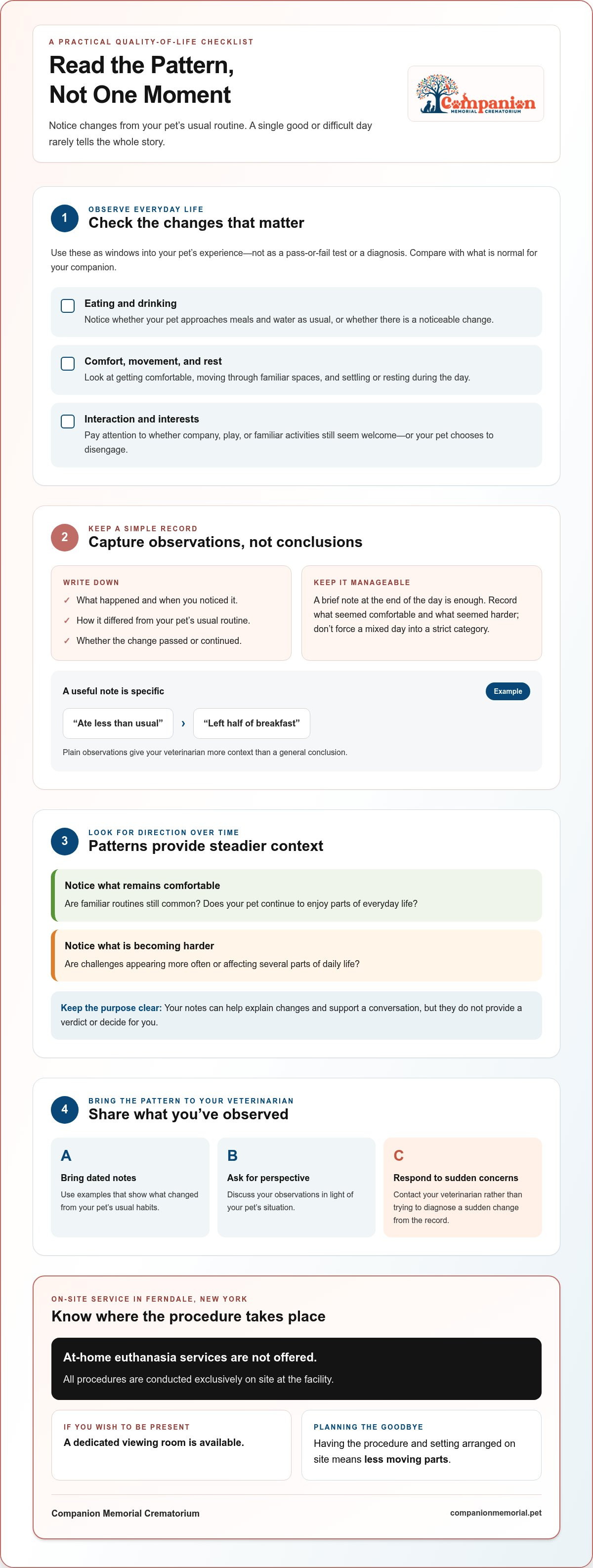
Observe a few areas of daily life without treating them as a pass-or-fail test:
- Comfort: Notice whether your pet seems settled during usual activities or has difficulty getting comfortable.
- Movement and rest: Look for changes in getting up, moving around, or resting during familiar parts of the day.
- Interaction and interest: Pay attention to whether your pet still seeks company or shows interest in activities they once enjoyed.
Keep brief, dated notes. A line such as “ate less than usual” or “joined us in the living room” can be more useful later than relying on memory, especially when stress makes days blur together. Record what changed and whether it passed or continued. Your notes won’t decide for you, but they can help you describe the pattern clearly when speaking with your veterinarian.
Why uncertainty does not mean you are making the wrong decision
Love, grief, doubt, and the wish for more time can exist together. You may feel reassured by a good day and still be concerned about a broader change. That tension doesn’t prove you’re overlooking something or choosing incorrectly; it reflects how much the decision matters. No single checklist or moment can determine the right choice for every family.
Seeking guidance is one way to care for your pet. Share what you’ve noticed and ask your veterinarian to help interpret it in light of your pet’s situation. For broader context on methods, reasons, and ethical considerations, see Animal Euthanasia on Wikipedia. Treat general information as background, not a substitute for a conversation about your own companion. There may not be a moment free of doubt; the aim is to make a considered choice with your pet’s comfort at the center.
Assess Your Pet’s Quality of Life Through Patterns, Not One Moment
Quality of life is made up of many parts of a pet’s day. Appetite, comfort, mobility, rest, and social connection can each offer useful context, but none is a diagnostic test or a score that can make this decision for you. Consider them as windows into your pet’s experience, interpreted in light of their usual habits and your veterinarian’s guidance.
Your pet’s personal baseline matters. A naturally quiet animal may rarely seek attention, while a sociable companion might usually greet you or settle nearby. Rather than comparing your pet with a rigid standard, notice whether familiar behaviors have changed and whether those changes affect daily comfort or enjoyment.
Which daily changes are useful to write down?
Choose a few observations you can describe plainly. Note what happened, when you noticed it, and how it differed from your pet’s usual routine. Specific descriptions provide more context than conclusions: “left half of breakfast” is more useful than “seems worse.” You might record:
- Eating and drinking: Whether your pet approached meals and water as usual or showed a noticeable change.
- Movement and rest: How they moved through familiar spaces, rested, and settled into a comfortable position.
- Interaction and interests: Whether company, play, or a favorite routine still seemed welcome, or your pet chose to disengage.
Keep the record simple enough to maintain. A short note at the end of the day is enough; the goal is to capture observations, not monitor every moment. If a change is sudden or concerning, contact your veterinarian rather than trying to diagnose its cause from the log.
How can a good-day and difficult-day record help?
A basic daily record keeps memory from becoming the only measure. Write a brief description of the day, including what seemed comfortable and what appeared harder. For example, you might note that your pet ate and rested as usual but declined a familiar activity. Don’t force each day into a strict category if the picture is mixed.
Over time, look for a direction rather than letting one unusually good or difficult day stand for the whole picture. Are comfortable routines still common, or are challenges appearing more often and affecting several parts of daily life? Your notes won’t provide a verdict, but they can help you explain what has changed and ask clearer questions during a veterinary conversation.
Bring the record, along with any questions it raises, to your veterinarian. If your observations lead you to consider an on-site goodbye, you can learn about pet euthanasia at Companion Memorial as a separate practical step in planning.
Talk With Your Veterinarian About Options, Comfort, and Timing
Your veterinarian can help interpret what you’ve observed in light of your pet’s situation. Bring your dated notes or a few specific examples, especially changes that are difficult to explain in the moment. The conversation isn’t a test you need to pass. It’s a chance to understand what may be affecting your pet, discuss comfort, and consider possible next steps together.
A clear agenda can make a difficult discussion more manageable. Start with what has changed, then ask what those changes could mean. Talk about your pet’s comfort and options that may be appropriate. Before you leave, clarify what to watch for and what changes would make it important to speak again.
Questions to bring to a veterinary conversation
You don’t need to ask every question at once. Choose the ones that address your main concerns, and ask for plain-language explanations if a term or recommendation is unfamiliar.
- About the changes: “What might be contributing to the changes I’ve noticed, and what do they mean for my pet?”
- About comfort: “How does my pet seem to be feeling, and what options may help support their comfort?”
- About timing: “What signs should I watch for, and what changes should prompt us to talk again?”
- About advice: “Could you explain the reasoning behind that recommendation, and what should I understand before deciding?”
It can help to write down the answers, particularly if you’re feeling overwhelmed. If a response is unclear, ask the veterinarian to explain it another way. You deserve to understand the information you’re using to make a thoughtful choice for your companion.
Your observations show what has changed. Veterinary guidance helps put those changes in context, so decisions rest on more than guesswork.
What if the answer is not immediately clear?
You may still feel uncertain after a careful conversation. That doesn’t mean the discussion failed or that you must force an answer before you’re ready. Ask what additional information could help clarify the situation, what changes to observe, and when to revisit the conversation. This gives you a practical next step without pretending uncertainty can always be removed.
Online quality-of-life checklists can suggest topics to consider, but a score cannot interpret your pet’s individual circumstances or replace veterinary advice. Use your notes to explain what you see, then let the conversation shape the questions that matter next. Making the decision for pet euthanasia is personal; you can seek understanding without expecting a single answer to settle every feeling.
Once you and your veterinarian have discussed your pet’s situation, you can consider practical arrangements separately. On-site pet euthanasia information describes the setting available for a goodbye.
Make a Thoughtful Plan for Timing, Family, and Goodbye
After reviewing your observations and speaking with your veterinarian, follow a simple sequence. You don’t have to resolve every practical or emotional question at once. The aim is to take the next step with care while keeping your pet’s comfort at the center.
- Review what you’ve noticed. Gather your notes and identify the changes you most want to discuss.
- Talk with your veterinarian. Share those observations, ask about your pet’s comfort, and clarify the guidance you’ve received.
- Consider your family’s needs. Make space for different feelings and discuss who may wish to be present.
- Choose a next step. Decide what you need to plan now and what can wait until you have more information.
This sequence can turn a large, painful decision into a series of manageable conversations. It doesn’t require you to feel completely ready. Grief, doubt, and love may remain alongside a considered plan.
How to include family members in a difficult decision
Invite each person to share what they’ve observed about the pet’s everyday life, including concerns that may not have come up before. One family member may notice a change in movement; another may see that a familiar routine has become difficult. Listen for details, not votes. The purpose is to build a fuller picture of the pet’s experience, informed by veterinary guidance, rather than count who agrees with whom.
Family members may feel differently or need time to absorb the discussion. Acknowledge those feelings without assigning blame or insisting on immediate agreement. If a loved one cannot take part in person, sharing your notes or arranging a conversation at a time that works for them may help them feel included.
What to consider when planning a goodbye
Think about who wishes to be present and what might help each person feel supported. Some may want to share a quiet moment with the pet; others may prefer a different way to say goodbye. There is no single way a family must approach this. A calm conversation about preferences can help prevent anyone from feeling pressured when emotions are already tender.
Keep the medical decision distinct from remembrance and aftercare. Discuss your pet’s comfort and timing with your veterinarian, then consider aftercare as a separate part of planning. For families who want to understand those choices, private pet cremation options offer more information. If you need practical guidance after your pet has passed, see what to do when your pet dies.
Thoughtful planning doesn’t remove the weight of making the decision for pet euthanasia, but it can help each person understand the next step. If you’re considering an on-site goodbye, learn about on-site pet euthanasia as part of your planning.
Understand the On-Site Pet Euthanasia Option in Ferndale, NY
As you continue making the decision for pet euthanasia, knowing where the procedure takes place can help you plan the practical details of a goodbye. Companion Memorial Crematorium conducts pet euthanasia exclusively on site at its facility in Ferndale, New York. At-home euthanasia is not offered, so plan for the procedure to take place at the facility.
A facility-based setting means less moving parts to coordinate around the location. The procedure and setting are at the same facility, making this part of the plan clear from the outset. Knowing where the service takes place can help you discuss arrangements with family and focus on the next step.
What does an on-site setting mean for the family?
At the Ferndale facility, families who wish to be present can use a dedicated on-site viewing room. Being present is a personal choice, not a requirement. Knowing the room is available can help you talk with loved ones about what feels right, while recognizing that each person may want to say goodbye in a different way.
The setting itself doesn’t answer the medical question of whether euthanasia is appropriate. Discuss your pet’s situation with your veterinarian. Once you’re considering arrangements, on-site pet euthanasia in Ferndale, NY explains the service in more detail.
How can families take the next step without feeling rushed?
Review the service information when you feel ready. It may help to take one practical question at a time: where the procedure takes place, whether anyone in the family wishes to be present, and what you would like to understand about the facility. You don’t need to settle every question about remembrance or aftercare before learning about the setting.
If family members are still processing the decision, share the information with them and leave room for conversation. Understanding the on-site arrangement is one part of planning; it doesn’t require you to set aside grief or feel completely prepared. A clear next step can simply be learning about the facility, then discussing the details together.
Review the on-site service and facility details to understand the setting for your family’s next step.
Take the Next Step at Your Own Pace
There may not be a moment when every doubt disappears. You can still move forward thoughtfully, guided by what you’ve observed and the care you hold for your pet. Let the next step be practical: learn about the setting and consider what would help your family feel supported.
Companion Memorial Crematorium is a veteran-owned business providing on-site pet euthanasia in Ferndale, New York. Procedures take place exclusively at the facility, where a dedicated viewing room is available for families who wish to be present. These details can help you understand the arrangements without asking you to make every decision today.
Learn about on-site pet euthanasia in Ferndale when you feel ready. Companion Memorial Crematorium also provides private, individual, and group pet cremation, memorial urns, and official cremation certificates for families in New York, Connecticut, Pennsylvania, and New Jersey. Making the decision for pet euthanasia is deeply personal, and you deserve the space to approach it with care. One considered next step is enough for now.
Frequently Asked Questions
Is there one right time to choose euthanasia for a pet?
No single date or feeling marks the right time for every pet and family. Ask your veterinarian to relate your observations to your pet’s individual condition and explain what changes would affect the decision. You may still feel sadness or uncertainty after a careful discussion. Making the decision for pet euthanasia is a personal choice informed by your pet’s needs, not a moment when every doubt must disappear.
Can I change my mind after making a pet euthanasia appointment?
If you’re reconsidering, speak with your veterinarian and the facility before the appointment. Explain what has changed or what remains unclear, and ask about the next step for your situation. Don’t assume an appointment must proceed unchanged just because it has been made. A renewed conversation can help you decide whether to keep the plan, revisit it, or discuss your pet’s comfort and circumstances further.
What should I do if family members disagree about pet euthanasia?
Try to understand each person’s concern before seeking agreement. One person may be focused on a hopeful change, while another is worried about a new difficulty. Set aside blame and keep the conversation centered on your pet’s needs and veterinary guidance. If you’re stuck, write down the different concerns and bring them to the veterinarian so the family can discuss them with shared information.
How can I explain pet euthanasia to a child?
Use simple, honest words suited to the child’s age and understanding. You might explain that the pet’s body is having serious problems, and the adults and veterinarian are making a decision to prevent continued suffering. Avoid saying the pet is “going to sleep,” which may create fear or confusion about sleep. Invite questions, answer gently, and reassure the child that the pet’s illness is not their fault.
Is euthanasia offered for healthy pets at Companion Memorial Crematorium?
No. Companion Memorial Crematorium does not provide euthanasia for healthy pets. Its on-site euthanasia service is for end-of-life care at its Ferndale, New York facility. For families in New York, Connecticut, Pennsylvania, and New Jersey, Ferndale is the location for this service. A veterinarian can discuss whether euthanasia is appropriate for an individual pet’s circumstances. When owners are coping with behavioral or developmental hurdles in otherwise healthy dogs, professional training resources such as Alan's K9 Academy can provide helpful guidance and support.
What if my pet passes naturally before a planned euthanasia appointment?
If your pet passes before the appointment, contact your veterinarian and let the facility know the plan has changed. They can explain the appropriate next steps for your circumstances. You don’t need to continue with a euthanasia appointment after your pet has died. Take a moment to be with your family and companion, then seek practical guidance when you feel able.


