

What if the guilt you feel after losing your pet isn’t proof that you failed them, but a reflection of how deeply you cared? Coping with pet loss guilt can mean replaying decisions, wondering whether you missed a sign, or imagining a different outcome. Those questions may feel especially heavy when people around you don’t understand how profound the loss is.
Make room for grief without judging yourself for it. You made choices with the information, time, and care available to you then, not with everything you know now. That difference can offer a gentler, fairer way to look back.
This article explores why guilt and regret can follow a pet’s death, and how love and hindsight can shape the questions that surface. You’ll find ways to reflect on difficult decisions with compassion, small steps for remembering your companion, and guidance on seeking support if grief feels difficult to carry alone.
Key Takeaways
- Feeling guilty after a loss doesn’t, by itself, mean you did something wrong.
- Separate what you know happened from fears and imagined alternatives.
- Revisit decisions with compassion, considering the information and choices available at the time.
- Try gentle ways to cope with pet loss guilt, from naming the feeling to finding a personal way to remember your companion.
- Talking with someone you trust or a grief professional may help you carry difficult feelings.
Why Can Pet Loss Bring So Much Guilt?
After a pet dies, you may find yourself returning to the same questions: Should I have noticed sooner? Did I make the right choice? Could I have done more? Replaying decisions can be part of grief, but the questions alone don’t prove you did something wrong. They may reflect how much responsibility you felt for a companion who depended on your care.
Post-loss guilt is painful self-blame connected to something you believe you did, failed to do, or should have done differently. The feeling can be convincing, but it isn’t evidence of wrongdoing by itself. Hindsight can make a past moment seem clearer than it was: now you know what happened next, while then you had only the information available at the time. Pet Loss on Wikipedia describes guilt as one emotion people may experience during pet bereavement.
“Guilt may be the mind’s search for control after a loss that could not be controlled.” Looking back can create the sense that a different choice would have changed everything. But imagining another outcome doesn’t establish that it was possible or that you could have known it then. Coping with pet loss guilt can begin by separating the painful question from the facts you had at the time.
How love, responsibility, and hindsight can become tangled
Caregiving involves a steady stream of decisions, from everyday routines to choices about comfort and medical care. After your pet is gone, even ordinary moments may seem newly significant. You might wonder whether a change in appetite deserved more attention or whether you should have spent one more evening at home.
It’s easy to judge those moments using information that arrived later. Try to recall what you observed, what you understood, and what options seemed available then. Guilt doesn’t have one cause for everyone, and noticing it isn’t a reason to dismiss your feelings. It’s a way to look at them in context.
Guilt and regret are related, but not identical
Guilt usually centers on perceived wrongdoing: “I did something wrong” or “I failed them.” Regret is more often a wish that events had unfolded differently: “I wish I’d had more time” or “I wish I’d known sooner.” These feelings can overlap, but regret doesn’t prove harmful intent or that you acted carelessly.
Choose one memory that keeps returning and ask which statement fits it more closely: “I believe I acted wrongly,” or “I wish the outcome had been different.” You don’t need to settle the question immediately. Naming the feeling can help you consider what happened fairly, rather than treating every painful memory as a verdict on your care.
What Can Pet Loss Guilt Be Telling You About Your Grief?
Guilt can gather around different parts of a relationship: daily caregiving, a final medical decision, time you wish you’d spent together, or the details of your pet’s last days. A thought such as “I should have noticed” may carry fear, sadness, or a wish that you could have changed what happened. The feeling deserves compassion, but it doesn’t establish blame by itself.
A painful feeling is not, on its own, proof of a failed responsibility. To understand what guilt may be pointing toward, separate what you know happened from the meaning your mind has attached to it. For example, you may know your pet seemed quieter one day; “I should have known this meant something serious” is an interpretation, not the same fact. The Ohio State University: Coping with Pet Loss resource encourages honest reflection and a reality check when guilt arises.
When the mind replays decisions and missed signs
Recurring questions can concern very different memories: whether to call a veterinarian, how to respond to a change in behavior, or whether you were present enough during a difficult period. There isn’t one pattern that fits everyone. When a memory returns, consider what you noticed at the time, what you understood, and what you could reasonably do with the information and choices available then. You don’t need to turn uncertainty into a judgment about your whole life with your pet.
When an end-of-life decision brings guilt
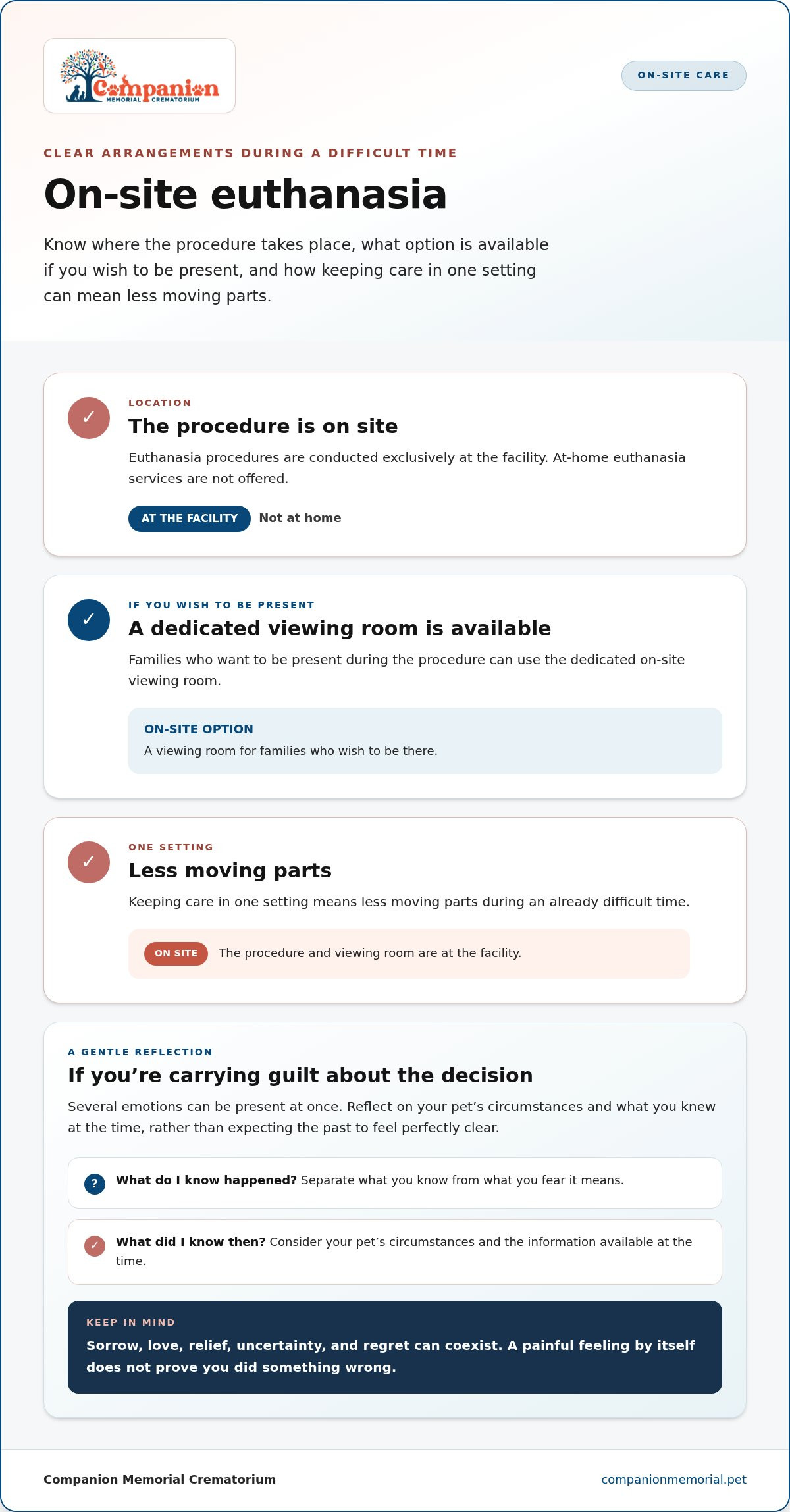
Choosing or considering euthanasia can bring several emotions at once. You may feel sorrow, love, relief that suffering has ended, uncertainty, or regret about the timing. As you reflect, focus on your pet’s circumstances and what you knew then, rather than asking yourself to make the past perfectly clear. For more context on the process, read this guide to on-site pet euthanasia in Ferndale, NY.
At Companion Memorial Crematorium, euthanasia procedures take place exclusively on site at the facility, not at home. Families who wish to be present can use the dedicated on-site viewing room. Keeping care in one setting means less moving parts during an already difficult time. You can learn about the facility’s on-site care and viewing room to understand the arrangements.
For now, you might ask yourself: “What do I know happened, and what am I afraid it means?” That question won’t erase grief or settle every doubt. It can help you approach coping with pet loss guilt with greater care, one memory at a time.
How to Review Regret Without Judging Yourself
Looking back can be painful, especially when one moment seems to stand for your whole relationship with your pet. Try narrowing the focus. You aren’t deciding whether you were a good person or a loving caregiver; you’re examining one memory fairly. A useful guide is this: Review a past decision using what you knew then, not what you know now.
If you feel ready, take these steps slowly. You can pause or stop whenever the reflection becomes too much.
- Name the memory. Describe one specific event in plain language, such as “I noticed a change in her appetite” or “I wasn’t present at the final moment.” Avoid turning it into a judgment about your entire relationship.
- Write down what you know. Note observable details, what you were told, and what you decided. Keep these separate from thoughts such as “I should have known” or “If only I had done something else.” Those thoughts may express fear or longing, but they aren’t facts by themselves.
- Consider the choices available then. Ask what information you had, how much time you had to respond, and what options seemed possible. Look at the circumstances as they were, rather than expecting yourself to have predicted what you learned later.
- Recognize the care you intended. Consider what you hoped to protect or provide for your pet. You can acknowledge uncertainty or sadness without assuming that your intentions or actions were harmful.
A compassionate way to revisit one difficult memory
Keep the review focused on the event. For example, separate “I waited until morning to call” from the assumption “I made everything worse.” If you can’t tell what belongs in each category, a trusted person may help you notice details that self-blame is making difficult to hold in view. Their perspective doesn’t have to settle the memory; it can simply make room for a fairer one.
When the question is whether you were present
Goodbyes unfold under different circumstances. Some people are present; others can’t be, or choose a different way to say goodbye. Neither response alone measures the depth of love. One final moment cannot contain the whole life you shared, including the ordinary days of companionship and care. If you need practical guidance after a death, what to do when your pet dies can help you consider next steps.
A review may not remove regret, and that isn’t its purpose. It can help you hold the memory more accurately: what happened, what you could know, and how you tried to care. This measured approach can support coping with pet loss guilt without demanding certainty or denying the sadness that remains.
Gentle Ways to Cope With Pet Loss Guilt Day by Day
Grief rarely follows a straight path. A day that feels manageable may be followed by one when a memory or question returns with fresh force. That change doesn’t mean you’ve gone backward, and there’s no fixed timetable you need to meet. Small, optional acts of care can help you meet the moment without demanding that you feel better right away.
Responding when self-blame returns
When a painful thought appears, try naming it gently: “I’m having the thought that I should have known.” This can create a little space to notice the thought without treating it as an established fact. You don’t have to argue with yourself or solve the memory immediately.
Pause before revisiting it. Feel your feet on the floor, take a slow breath, or name a few things you can see around you. Then ask what you need right now: a quiet moment, a glass of water, or another person’s company. If the thought continues to weigh on you, consider telling someone you trust what you’re carrying. You could say, “I don’t need you to fix this; could you listen while I talk about it?”
Remembering your pet in a way that feels right
Remembrance can be private, shared, simple, or something you choose not to do right now. You might tell someone a story about your pet, keep a photograph nearby, write down a small detail you don’t want to forget, or create a personal ritual that feels meaningful. You can also set these ideas aside. There is no required memorial practice, and the way you grieve isn’t a test of how much you loved your companion.
If remembering brings comfort one day and sadness the next, both responses can belong. A keepsake or memorial choice may honor your bond, but it doesn’t have to remove guilt or complete your grief. For inspiration, explore these pet memorial services in Sullivan County, NY as one possible way to mark your companion’s place in your life.
For today, choose only what feels manageable. You might name the feeling, take a pause, or reach out to someone who can sit with you. Coping with pet loss guilt doesn’t require a perfect routine or a quick resolution; it can mean offering yourself patience through changing days. You can also explore ways to honor your companion. Any choice is yours, and it need not carry the burden of making grief disappear.
Finding Steady, Compassionate Support After Pet Loss
Grief can be difficult to carry alone, especially if guilt keeps returning or everyday responsibilities feel harder to manage. You don’t need to wait until you have the right words to reach out. A trusted person may listen, while a grief professional can offer dedicated space to explore difficult feelings at your own pace. Even tuning into reflective audio and shows like ellapodcasts.com can provide gentle company during quiet moments when you are not quite ready to talk.
When grief feels too heavy to carry alone
If distress feels overwhelming or interferes with daily life, consider speaking with a qualified grief professional. You might tell someone close to you, “I need you to listen without trying to solve this right now.” Being specific can help them understand what would feel supportive. You can start with a single memory or question; you don’t have to explain everything at once.
It may help to write down what you’d like to discuss before a conversation, especially if you worry you’ll lose your words. Note the thought that troubles you most, what tends to bring it back, or what kind of response you hope for. Emotional support gives you room to process your experience. Practical aftercare decisions serve a different purpose, and one doesn’t replace the other.
Choosing practical support at your own pace
Some families find it helpful to learn about arrangements and memorial choices when they feel ready. Others prefer to wait. You can gather information without making an immediate decision, and you don’t need to treat any particular choice as a measure of your love or progress. Let the pace be yours.
Companion Memorial Crematorium offers families practical options for honoring a pet. You can explore Companion Memorial Crematorium’s services when you feel ready. Seeking support for grief and considering arrangements are separate steps, and you may take either one at a time.
Take the Next Step at Your Own Pace
There’s no need to resolve every question about the past before taking a small step toward support. If guilt returns, meet it with patience and seek company when carrying it alone feels difficult. Coping with pet loss guilt is not about forgetting your companion or finding a perfect explanation. It’s about allowing compassion to sit beside sorrow as you continue forward.
If you’re considering aftercare, Companion Memorial Crematorium is 100% combat veteran-owned and offers private, individual, and group cremation options for families in New York, Connecticut, Pennsylvania, and New Jersey. These choices can help families make arrangements that feel appropriate to them, though they don’t replace emotional support or set a timetable for grief.
When you feel ready, learn about Companion Memorial Crematorium’s on-site care and memorial options. Take the time you need. Your bond with your pet remains meaningful, and you deserve gentleness as you carry it with you.
Frequently Asked Questions
How long does guilt after losing a pet last?
There’s no single timeline for guilt or grief. The feeling may soften, return around reminders, or change as you adjust to life without your pet. Try not to use how quickly guilt fades as a measure of your love or progress. If it remains overwhelming or makes ordinary responsibilities difficult, consider speaking with a grief professional or someone you trust. You can seek support even if you’re unsure what you need.
Why do I feel guilty when my pet died suddenly?
A sudden loss can leave unanswered questions and little time to prepare, so your mind may search for an explanation or replay what happened. That search doesn’t show that you could have prevented the death. If you’re able, write down what you knew before the loss and what you learned afterward. Keeping those details separate may help you understand the questions without having to answer all of them alone.
Can I feel guilty even if my pet died naturally?
Yes. Guilt can arise after a pet dies naturally, even when there was no end-of-life decision. You might wonder whether a change in behavior was significant or whether you should have acted sooner. Consider what you observed at the time, rather than judging yourself with information that came later. If reviewing the circumstances leaves you distressed, a trusted person or grief professional can help you talk through them.
How can I explain my guilt about losing a pet to my child?
Use clear, age-appropriate words, and let your child know they can ask questions or share feelings. You might say, “I feel sad and sometimes wish things had gone differently, but you don’t have to fix my feelings.” Invite them to remember the pet through a story or drawing, but let them choose whether to take part. If either of you feels overwhelmed, consider finding additional support together.
Why does guilt return around my pet’s adoption or death anniversary?
Dates tied to your pet may bring memories and feelings close again, even after a period that felt easier. If an anniversary is approaching, decide in advance what would make the day manageable: keeping your schedule light, sharing a story, or asking someone to check in. You can also let the date pass without marking it. Guilt returning on a particular day doesn’t erase the care you’ve shown.
Can I grieve a pet even if other people do not understand?
Yes. Your grief is real even if someone else doesn’t recognize the importance of your relationship. If a conversation feels dismissive, you can set a boundary, such as saying, “I’m not looking for advice; I just need you to hear me.” Seek connection with someone who respects the bond you shared. Whether you’re in New York, Connecticut, Pennsylvania, or New Jersey, you deserve space to mourn without having to defend your feelings.


