

What if the most helpful question isn’t simply whether sedation will be used, but why a particular approach is recommended for your pet? No-sedation pet euthanasia concerns often come from a loving wish to prevent fear or discomfort, alongside uncertainty about what sedation does and doesn’t mean.
It’s understandable to worry about what your pet may experience and to find it difficult to discuss preferences during an emotional appointment. Medication decisions depend on the individual pet and veterinary judgment, so a clear conversation beforehand can help you understand the recommendation and share what matters to you. This article outlines questions to raise before the appointment, how those decisions may be considered, and what to expect from an on-site visit.
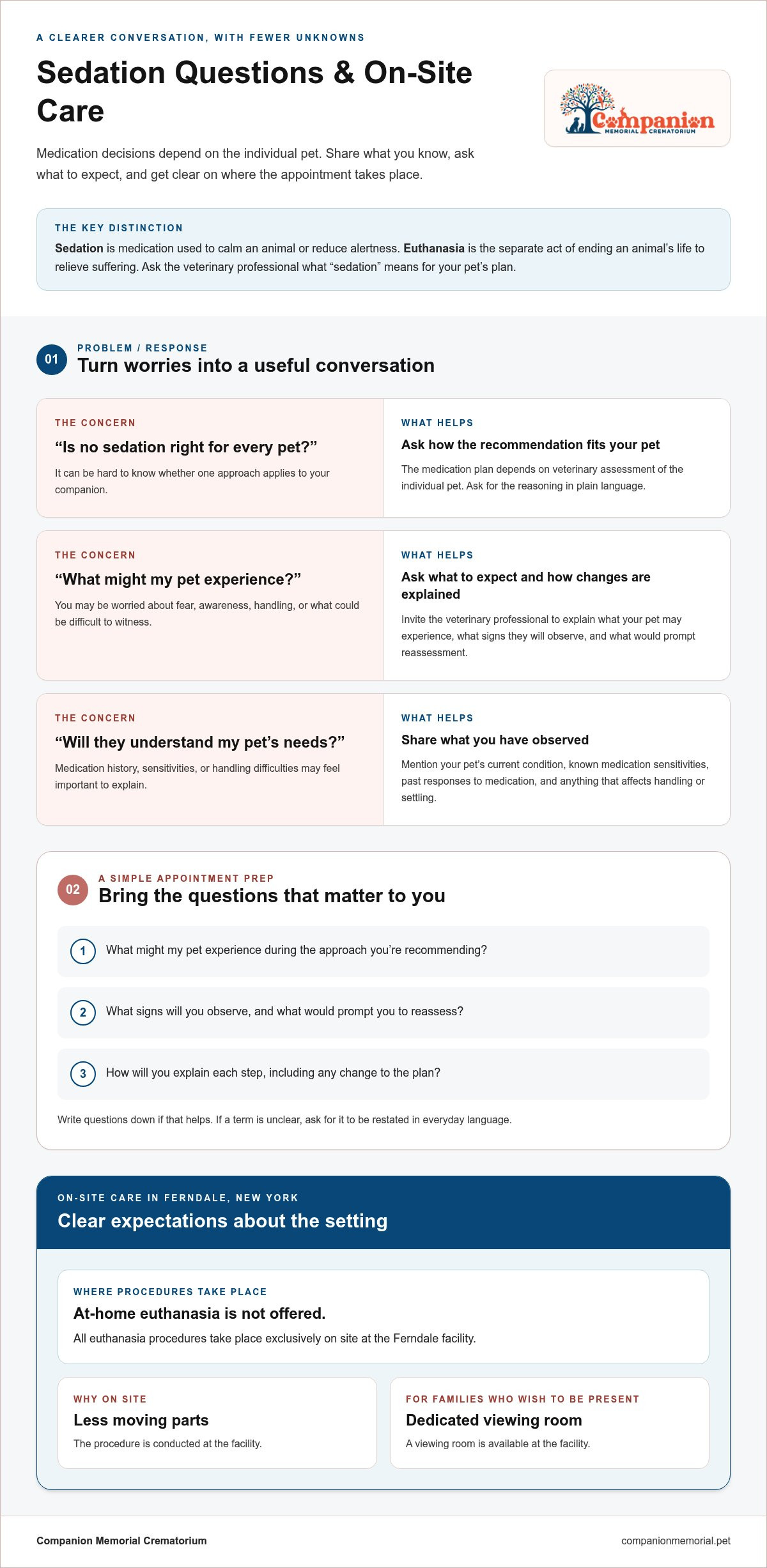
At Companion Memorial Crematorium, euthanasia procedures take place exclusively on site at the Ferndale facility. Having the procedure at the facility means less moving parts, and a dedicated viewing room is available for families who wish to be present. With clear expectations and time to talk through your concerns, you can prepare for the visit without feeling rushed.
Key Takeaways
- No-sedation pet euthanasia concerns are best explored through a calm conversation about your pet’s needs, rather than assumptions about one approach being right for every animal.
- Share your pet’s current condition, known sensitivities, and past responses to medication so the veterinary professional can consider them when discussing sedation.
- Prepare questions about the medication plan, what your pet may experience, whether you can be present, and who will explain each step.
- Companion Memorial Crematorium’s euthanasia appointments take place exclusively on site in Ferndale, New York. Families who wish to be present can use the dedicated viewing room.
- Knowing the setting and preparing your questions ahead of time can help you feel more ready to discuss your preferences without rushing your decision.
No-Sedation Pet Euthanasia Concerns: What Does the Question Mean?
Uncertainty about medication is understandable when you’re preparing to say goodbye to a beloved companion. You may be trying to understand whether your pet will feel afraid, what they’ll be aware of, or whether sedation changes the euthanasia procedure itself. These are thoughtful questions, not signs that you’re making the decision incorrectly.
Sedation refers broadly to medication used to calm an animal or reduce alertness. Euthanasia is the separate act of ending an animal’s life to relieve suffering. The terms can arise together in a discussion, but they don’t mean the same thing. As a general reference, Animal euthanasia provides an overview of the purpose and methods of euthanasia; the veterinary professional can explain how the plan applies to your pet.
Sedation is a medication approach discussed in the context of an individual pet, not a universal step that means the same thing for every animal. Asking what the veterinary professional means by “sedation” can clarify the language before you consider a recommendation.
What owners may mean by no sedation
A question about “no sedation” may reflect several different worries. You might be asking whether your pet will feel comfortable, remain aware of what’s happening, need to be handled in a way that feels upsetting, or appear distressed in a way that could be difficult for you to witness.
The word “sedation” can also refer, in everyday conversation, to different medications or stages of care. Rather than assume you and the veterinary professional mean the same thing, describe the concern underneath the question. For example: “I’m worried my pet might be frightened,” or “I want to understand what I may see.”
Why there is no one-size-fits-all answer
A concern about no sedation is a question to discuss with the veterinary professional, not a diagnosis of what your pet needs. The veterinary professional considers the individual animal and circumstances when explaining medication choices. One approach shouldn’t be assumed to apply to every pet, and a general description can’t predict the right plan for your companion.
Ask for an explanation in plain language, pause if a term is unclear, and share what you’ve observed about your pet. Asking about the plan is appropriate. It gives the veterinary professional a chance to understand your concerns and explain the reasoning behind the care being discussed, so you can take part in the conversation with greater clarity.
What a Veterinarian Considers When Discussing Sedation
A sedation conversation should help you understand how your pet’s circumstances inform the care being discussed. It isn’t a test with answers that automatically lead to a particular medication plan. Share what you know about your companion and ask the veterinary professional to explain the intended approach in language that feels clear to you.
The appropriate medication plan depends on a veterinary assessment of the individual pet. That assessment takes place in the context of your pet’s condition and the information you provide. The AAHA Euthanasia and End-of-Life Care Guidelines discuss sedation and anesthesia in end-of-life care, but general guidance doesn’t determine what is suitable for every animal. The veterinary professional can explain how guidance relates to your pet’s situation.
The pet’s condition and handling needs
Before the appointment, consider sharing relevant details about your pet’s current condition, known medication sensitivities, and previous responses to medication. Mention anything that may affect handling, such as a strong fear of being touched in a particular area or difficulty settling in unfamiliar surroundings. These details don’t determine a treatment plan on their own; they give the veterinary professional useful context for the discussion.
Comfort and calmness are reasonable concerns to raise directly. You might say, “I’m worried my pet will feel frightened,” or “Handling has been difficult lately.” Then ask how those concerns factor into the approach being considered. You don’t need to interpret your pet’s medical history or suggest a specific medication. Share what you’ve observed and ask for an explanation.
The owner’s questions and preferences
No-sedation pet euthanasia concerns can include fear about what the pet may experience, uncertainty about what staff will observe, and worry about seeing a change that feels unexpected. Naming your main concern makes the conversation more useful. If several questions come to mind, write them down so emotion doesn’t make them harder to express at the appointment.
- “What might my pet experience during the approach you’re recommending?”
- “What signs will you observe, and what would prompt you to reassess?”
- “How will you explain each step, including any change to the plan?”
These questions invite information without assuming the answer in advance. If an explanation includes unfamiliar terms, ask for them to be restated in everyday language. You can also describe what you’re most afraid of witnessing, so the veterinary professional understands what preparation or explanation may help you feel informed.
A clear conversation should leave you understanding the intended approach and how a change would be communicated, without requiring you to choose a clinical pathway yourself. Companion Memorial Crematorium provides on-site pet euthanasia services at its Ferndale facility, where families can discuss their concerns as they prepare for the appointment.
Sedation or No Sedation: How to Think Through the Options
It can be tempting to compare sedation and no sedation as if one must be the more comfortable or compassionate choice in every situation. A more useful discussion focuses on your pet’s circumstances: what the veterinary professional recommends, what that approach is intended to support, and what you can expect to see. Perceived benefits and concerns can differ depending on the individual animal and circumstances of care.
The veterinary professional determines and explains the clinically appropriate plan. Your questions can help you understand the reasoning without asking you to make a clinical judgment yourself. If you’re weighing no-sedation pet euthanasia concerns, use questions like these to make the conversation specific to your companion:
| Question to consider | Why it matters | What to discuss with the veterinarian |
|---|---|---|
| What is the proposed approach intended to support for my pet? | It can clarify the purpose of the recommendation without assuming that one option is right for every animal. | Ask how your pet’s condition and circumstances inform the plan. |
| What might my pet experience at each stage? | A plain-language explanation can help you prepare and distinguish what you’re worried about from what the veterinarian expects. | Ask what you may observe and which parts of the experience the veterinary professional can describe in advance. |
| What signs will staff monitor, and how would they respond to an unexpected change? | Knowing what the care team is watching for can make the plan feel less uncertain. | Ask how changes would be recognized and explained to you. |
Questions that make the comparison clearer
Use the same questions to understand any approach being discussed, rather than treating sedation and no sedation as rival choices with predictable outcomes. You might say, “What are you hoping this approach will support for my pet?” or “Could you talk me through what you expect my pet may experience?” If your concern is a particular sign or reaction, name it directly and ask whether it’s something staff monitor.
You can also ask how the veterinary professional would explain an unexpected change in the plan. That conversation won’t predict exactly what will happen, but it can clarify how decisions are communicated and give you space to ask follow-up questions.
Avoiding assumptions about comfort
The presence or absence of sedation alone can’t guarantee a particular experience. Avoid relying on broad promises that either approach will be entirely calm or free of distress. A careful explanation should acknowledge what’s known about your pet and what can’t be predicted with certainty. If something remains unclear, ask the veterinary professional to explain it in direct, understandable language.
Your role is to share your concerns and understand the recommendation. The veterinary professional’s role is to assess your pet and explain the clinically appropriate plan. That distinction can help you take part in the conversation without feeling responsible for choosing a medication or determining the clinical pathway.
Questions to Ask Before a Pet Euthanasia Appointment
It can be hard to find the right words during an appointment filled with emotion. Preparing a few questions ahead of time can help you explain what matters to you, understand the proposed medication plan, and feel more ready to take part in the conversation. You don’t have to ask every question or have everything settled before you arrive.
Use this list as a starting point. Choose the questions that speak to your concerns, and add anything specific to your pet’s history or your wishes.
Questions to bring to the conversation
- Could you explain the proposed medication approach in plain language?
- How are my pet’s condition and comfort being considered in this plan?
- What might my pet experience, and what should I expect to see?
- May I be present, and what should I know about being there?
- Who will explain each step as it happens?
- If a concern arises or the plan needs to change, whom should I speak with?
These questions are meant to open a discussion, not to determine the clinical plan for you. If you’re worried about no sedation, describe the specific fear behind that concern. You might say, “I’m afraid my pet will feel frightened,” or “I’m unsure what I’ll see.” The veterinary professional can then respond to the concern you’re expressing and explain the approach being considered for your companion.
Prepare at your own pace
Before the appointment, think about what you most hope to understand. Perhaps it’s the reason for the medication plan, whether you can remain present, or how staff will communicate during the procedure. A short note on your phone or a piece of paper can help if emotion makes it difficult to remember your questions in the moment. You can also bring someone you trust to listen and help remember the answers, if that feels right for you.
Share your wishes and concerns before the appointment begins, or ask for a moment to talk if something comes to mind later. It’s appropriate to request plain language, ask for clarification, or pause to gather your thoughts. A calm discussion doesn’t require you to be certain about every preference in advance. It gives you and the veterinary professional a chance to understand one another before moving forward.
The setting is another practical detail to plan for. Companion Memorial Crematorium’s euthanasia service takes place on site at the Ferndale facility, with a dedicated viewing room for families who wish to be present. Knowing where the appointment will take place and whether you want to use the viewing room can help you prepare for the visit. You can also explore on-site pet euthanasia information as you prepare.
After the appointment, families may have practical questions about what comes next. Give yourself room to consider those separately; you don’t need to resolve every part of saying goodbye in one conversation.
On-Site Pet Euthanasia in Ferndale: Clear Expectations and a Viewing Room
Knowing what you want to understand before an appointment can help make the visit feel more manageable. Consider which practical details would ease uncertainty, such as where to go when you arrive, how the appointment will begin, and when you’ll have a chance to speak with the veterinary team. Raising these questions while planning can make the visit easier to navigate.
What the on-site setting means for families
At Companion Memorial Crematorium, all euthanasia procedures take place on site at the Ferndale facility. The visit is not conducted at home, so you can plan for your pet’s trip to the facility and think through what would make that travel more manageable for your family. Having the procedure in one setting means less moving parts and gives families a dedicated viewing room where they can be present.
Before the appointment, write down practical questions such as where to go when you arrive and whom to speak with if you need clarification. If you’re traveling to Ferndale from elsewhere in New York, Connecticut, Pennsylvania, or New Jersey, allow yourself time to arrive and get oriented. These details can help you feel prepared without making assumptions about the clinical plan or your pet’s experience.
Choosing whether to be present
Being present is a personal choice. You may know you want to stay with your companion, feel uncertain, or need more information before deciding. The dedicated viewing room at Companion Memorial Crematorium provides a space for families who wish to be present. Think about what would help you feel supported, and share your preference or hesitation with the veterinary team. You can ask what to expect if you remain with your pet and who will guide you through the visit.
If you’re unsure, you don’t need to decide based on what you think other families would choose. Consider what feels manageable for you and the people accompanying you. It may help to talk through your concerns in advance, then take a moment to revisit your preference when you have a clearer understanding of the arrangements.
Approaching the visit one question at a time can make the practical details easier to process. You can focus first on what you need to know, then allow space for the decisions that feel most personal to your family.
Take the Next Step at Your Own Pace
You don’t need to resolve every question at once. A helpful next step may be to choose the one concern you most want answered and write it down, so it’s easier to raise during a conversation with the veterinary professional. Your questions and preferences matter, even if you’re still unsure what you want.
No-sedation pet euthanasia concerns are part of a deeply personal decision. Seeking a clear explanation isn’t a demand for certainty; it’s a way to understand the recommendation and make room for a thoughtful choice. Companion Memorial Crematorium is a 100% combat veteran-owned company, committed to serving families with care during a difficult time.
If you’re considering an appointment, take the next step when you feel ready. Learn about on-site pet euthanasia in Ferndale and give yourself space to prepare for the conversation.
Your bond with your companion is unique. Move forward gently, one question at a time.
Frequently Asked Questions
How long does a pet euthanasia appointment take?
There isn’t a reliable fixed duration for every appointment; timing can vary with your pet’s circumstances and the conversation needed. When planning your visit to the Ferndale facility, allow space for questions and the time you need with your companion. Families traveling from elsewhere in New York, Connecticut, Pennsylvania, or New Jersey may find it helpful to keep the day flexible rather than build plans around a fixed estimate.
Can children be present during a pet euthanasia appointment?
Whether a child should attend is a decision for the family to discuss with the veterinary team, since what feels appropriate can differ from one child and family to another. Consider what the child understands, what they want to know, and how you might explain the goodbye in age-sensitive language. Talk through the child’s presence with the team as part of preparing for the appointment.
Can other pets come to a pet euthanasia appointment?
Don’t assume another pet can or should attend. Talk with the veterinary team about the animal’s temperament, the appointment setting, and what may be manageable for everyone. For example, consider whether your other pet is comfortable in unfamiliar places and around new people. Another animal’s presence shouldn’t be counted on to create comfort or a particular response.
What should I bring to a pet euthanasia appointment?
Keep preparation simple: bring relevant information the veterinary team has asked you to have available, and consider taking a written list of questions. You might note anything you’re concerned you’ll forget to mention. Think ahead about any personal items you’d like with you, and discuss practical arrangements for your visit as you plan. The focus can stay on what helps you feel prepared and supported.
Can I change my mind after discussing euthanasia?
If you’re uncertain, tell the veterinary professional before proceeding and ask for time to understand the options. You can explain what still feels unresolved, such as a question about your pet’s circumstances or the recommendation. The veterinary professional can discuss the situation and help clarify what choices are appropriate to consider. You don’t need to hide your uncertainty, and you shouldn’t feel pressured to make a decision before you understand the discussion.
What if I still feel unsure about the sedation discussion?
It’s reasonable to ask the veterinary professional to explain the plan again, define unfamiliar terms, or address the specific concern that remains troubling you. No-sedation pet euthanasia concerns can feel harder to discuss in the moment, so write down the question or ask to pause while you gather your thoughts. You deserve a clear explanation, but the decision about the clinically appropriate approach belongs with the veterinary professional.


