
Could a place that feels peaceful and meaningful still be off limits for scattering your pet’s ashes? In New York, the answer depends on who owns or manages the location. Pet ash scattering laws New York families encounter can therefore vary between private property, parks, cemeteries, and waterways.
It’s understandable to expect one statewide rule or to assume that guidance for human ashes applies equally to pets. But location-specific rules matter, and permission from the property owner or managing authority is an important starting point. This guide explains why the rules differ, how to seek current guidance from local offices and land managers, and why it’s important not to rely on assumptions about human remains when making plans for a pet.
If scattering isn’t suitable for the place you have in mind, a private memorial garden may offer a respectful alternative. Companion Memorial Crematorium is 100% combat veteran-owned. Its group cremation service includes scattering remains in a private memorial garden, and those remains are not returned to the owner. The sections ahead will help you consider your options with care and clarity.
Key Takeaways
- Pet ash scattering laws New York families need to consider depend on the location and who owns or manages it.
- New York State Parks, New York City Parks, local parks, private property, and waterways may follow different rules.
- Before making plans, identify the site manager and verify the current policy for pet ashes through an official source.
- Ask the responsible office whether written permission is needed, then follow its guidance before scattering.
- If scattering isn’t suitable, another thoughtful memorial can honor your pet and the bond you shared.
Pet Ash Scattering Laws in New York: Why the Location Matters
Choosing a place that feels connected to your pet is deeply personal. The practical answer depends on who owns or manages that location. New York has no single statewide rule restricting where pet ashes may be scattered, so relevant guidance may come from a state agency, New York City, a local government, a cemetery, a private landowner, or a federal land manager.
Separate authorities set policies for the places they oversee. New York State Parks and New York City Parks are different systems, while a town park may follow local rules. Private property is subject to the owner’s permission, and federally managed areas have their own managers and requirements. Don’t assume a rule for one site applies across the state.
Permission-first approach: Before scattering, identify who owns or manages the site and obtain that authority’s permission or current guidance. The New York State Division of Cemeteries advises that scattering ashes without the property owner’s permission is illegal. Because that guidance may not expressly address pet ashes, don’t treat it alone as a definitive statement of pet-ash law.
Does one New York law cover every place?
No single rule answers every location question. State law, local ordinances, and site-specific policies can each be relevant, and the manager’s rules may determine whether scattering is allowed on a particular property. A cemetery, for example, may have its own procedures, while a public park may be governed by the agency responsible for it.
For the pet ash scattering laws New York families need to understand, start with the exact site, not a general statement about “New York.” Check the current official guidance for the property and contact the responsible office if the policy is unclear. Don’t assume a location permits scattering simply because another park or property does.
Do human ash rules apply to pet ashes?
Not automatically. Some public guidance about scattering cremated remains is written for human remains. That does not by itself establish that the same rule applies to an animal’s cremated remains. Before relying on a human-focused law or policy, look for language that specifically covers pets, animals, or all cremated remains. If it’s silent, ask the agency or land manager how it interprets the policy.
For legal context, check current New York statutes and relevant agency guidance, then compare them with the rules for the specific property. The Cremation practices and disposal of remains overview offers general background, but it isn’t a source of New York legal requirements. For decisions about a particular site, rely on the responsible authority’s current instructions and clarify whether they apply to pet ashes.
New York Rules for Pet Ashes on Parks, Private Land, and Water
A park’s name or a shoreline’s quiet setting doesn’t establish that scattering is allowed. The guidance below points you toward the authority to consult, but agency information may address cremated remains generally or human remains specifically. Before making plans, verify whether the current policy covers pet ashes and permits scattering at the exact site.
What should New York pet owners know about parks?
New York City Parks and New York State Parks are separate systems with different guidance. NYC Parks describes conditions for scattering on its property, while New York State Parks regulations restrict leaving or dispersing ashes without special approval. Neither should be treated as a statewide rule, and pet owners should confirm whether the policy applies to animal ashes. Local parks have their own managing offices, so check with the city, town, or county that operates the specific property.
| Location type | Managing authority | Permission question | Verification source |
|---|---|---|---|
| NYC Parks | New York City Parks | Does the current guidance cover pet ashes, and what conditions or permits apply? | NYC Parks official guidance or the responsible park office |
| New York State Parks | New York State Office of Parks, Recreation and Historic Preservation | Is scattering prohibited at this site, or is special approval available for pet remains? | Current state park regulations and OPRHP |
| Local parks | City, town, or county agency | Does the local policy allow pet-ash scattering, and are there site restrictions? | The park’s official managing department |
| Private property | Property owner or authorized manager | Has the owner given permission for this specific use? | Direct written permission from the owner or manager |
| Cemeteries | Cemetery operator | Does the cemetery accept pet ashes, and what procedures does it require? | The cemetery’s current policies and office |
| Inland waters or coastal areas | Relevant local, state, or federal authority | Which rules apply to this waterway and to pet ashes? | For inland waters, consult the county board of health or NYSDEC; for coastal locations, identify the responsible federal and site authorities |
| Federal lands | National park or forest manager | Is scattering allowed here, and is written approval or a permit required? | The specific park or forest’s official guidance or ranger office |
How do private land, cemeteries, and waterways differ?
On private property, speak with the owner or authorized manager before scattering. Don’t rely on silence as consent. Cemetery policies are separate from state law, so ask the cemetery office whether pet ashes are accepted and what rules apply. For lakes, rivers, or coastal sites, the responsible authority can depend on the waterway and its location. Don’t assume a rule for one body of water applies to another, or rely on a distance or permit requirement without checking current official guidance.
When weighing pet ash scattering laws New York families need to consider, verify the exact site’s current pet-ash policy before treating any location as permitted. If a private memorial setting feels more suitable, Companion Memorial Crematorium's group cremation includes scattering in a private memorial garden. The remains are not returned to the owner. Learn about Companion Memorial Crematorium as you consider a respectful option.
How to Check Whether a New York Site Allows Pet Ash Scattering
Before choosing a date or gathering place, confirm the site’s current rules for pet ashes. Policies can differ between locations and may change, so information that applied in the past may not reflect the guidance in effect in 2026. Checking with the responsible authority can help prevent a meaningful moment from becoming an unexpected problem.
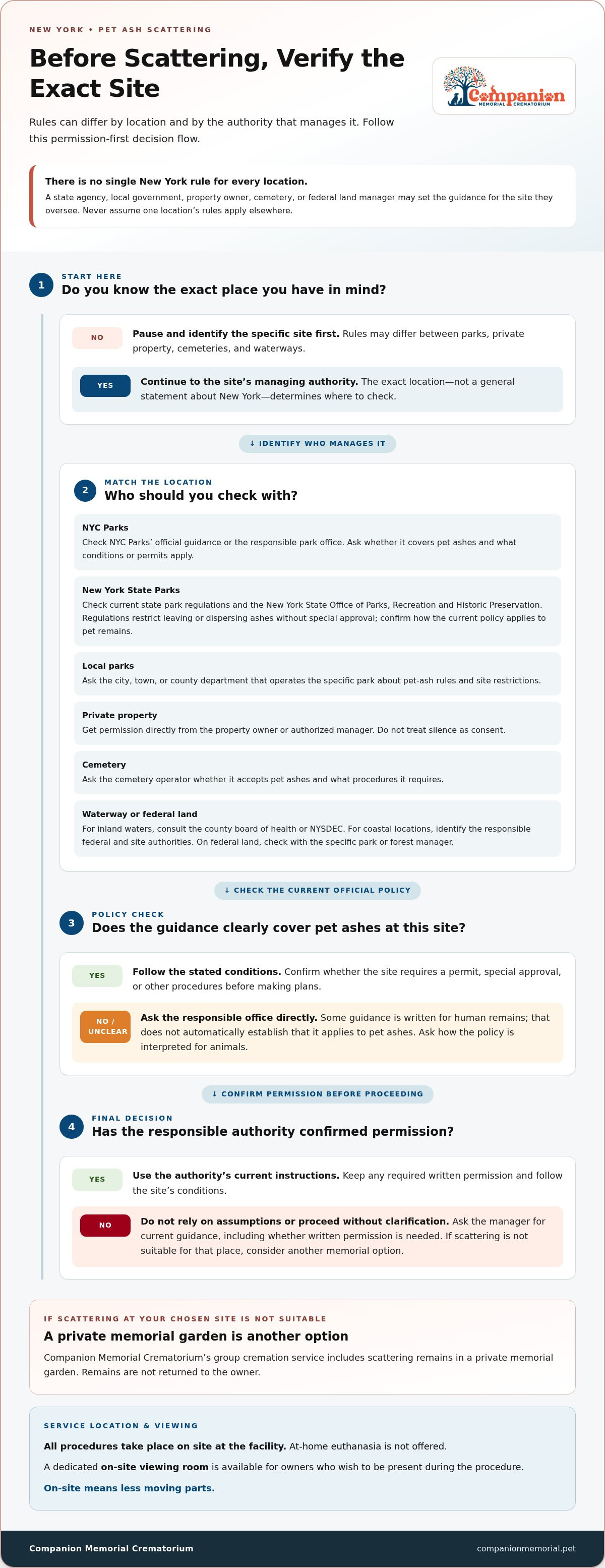
Use this sequence:
- Identify the exact site. Record the park, cemetery, waterway, or property name, along with the particular area you have in mind.
- Find its manager. Check the site’s official website or contact information to determine which agency, organization, or owner controls it.
- Verify the pet-ash policy. Look for current official rules, then contact the responsible office if the guidance discusses cremated remains generally or doesn’t clearly mention animals.
- Plan only after you have an answer. Ask whether permission must be in writing and keep any response or approval with your arrangements.
Which authority should you consult?
Start with the organization responsible for the specific place. For property in the New York City Parks system, consult NYC Parks; for a New York State Park, consult the state park authority. A local park’s city, town, or county department is the relevant contact for its property. On private land, speak with the owner or authorized manager. For a cemetery or waterway, identify the operator or agency responsible for that site.
Official webpages can help you locate rules, but a general page may not settle whether pet ashes are covered. If the answer is unclear, direct your question to the office that manages the property. Ask for current guidance or a written reply rather than relying on an old post, an unofficial summary, or guidance for a different location.
What questions help prevent misunderstandings?
Be specific when you contact the office. Name the site and explain that the remains are from a pet, not a person. Ask whether scattering is allowed at that exact location, whether advance permission or a permit is required, and whether any limits apply to the area or ceremony. If the rules use broad wording, ask how the office applies it to pet cremated remains.
- Are pet cremated remains covered by this policy?
- Are there designated or restricted areas, including nearby paths or water?
- Do group size, timing, or ceremony details affect permission?
- Are there rules about containers, leaving items, or how remains are dispersed?
- Can you provide the current guidance or permission in writing?
Make the inquiry before inviting family or making travel plans. Confirm the details again if time passes or the site’s guidance changes. These steps bring clarity to decisions about pet ash scattering laws New York without assuming that permission at one location applies elsewhere.
If you’re considering a different memorial, Companion Memorial’s pet cremation services offer another path to explore. Companion Memorial is 100% combat veteran-owned.
Choosing a Respectful Memorial When Scattering Is Not Suitable
Learning that a place isn’t suitable for scattering can feel disappointing, especially if you pictured a particular setting for your pet’s memorial. It doesn’t lessen the love behind that wish. Another arrangement can still honor the companionship, routines, and memories that made your pet part of your family.
There’s no single memorial choice that is right for everyone. Some families value having their pet’s remains returned; others may prefer an arrangement that doesn’t require them to keep or later place the ashes. Consider what would feel comforting over time and what each option means for the remains. Understanding those details before deciding can help you feel more settled in your choice.
What does the private memorial garden option involve?
Companion Memorial’s group cremation service includes scattering the remains in a private memorial garden. The remains are not returned to the owner. This is a pet-specific memorial arrangement, not a legal ruling about whether scattering is permitted in a public park, cemetery, or other location. Rules for any separate property still depend on that site’s owner or manager.
For families who prefer to keep their pet’s remains, private cremation includes a wood urn and cremation certificate, with an optional private viewing. Euthanasia services are provided on site only, not at home, and only for pets facing suffering or a significantly reduced quality of life. The dedicated on-site viewing room is available for families who wish to be present during the procedure. Having the process at the facility means less moving parts and a controlled, private setting. The guide Pet Cremation Options Explained can help clarify the differences between cremation choices.
How can families compare memorial choices?
A managed memorial setting and keeping remains at home offer different ways to remember a pet. With group cremation, scattering takes place in the private memorial garden and the remains aren’t returned. With private cremation, the remains are returned in an urn. Neither choice is more meaningful by default. Consider whether you’d find comfort in a dedicated place or in having the urn with you.
Families may also want to think about who will take part in remembering their pet, whether they want a private moment or a shared gathering, and what feels manageable in the days ahead. These are personal considerations, not requirements. For broader ideas about honoring a companion, the guide Honoring a Lifetime of Love: Pet Memorial Services in Sullivan County, NY explores memorial choices. The guide Private Pet Cremation: A Guide to Dignified End-of-Life Care in 2026 offers more context on private cremation.
Questions about pet ash scattering laws New York may lead you to reconsider a planned location, but you can still choose a memorial that reflects your bond. To explore Companion Memorial’s group or private cremation options, view pet cremation options.
Planning Pet Ash Scattering in New York with Care and Clarity
A thoughtful plan begins with two decisions: what kind of memorial feels right for your family, and whether the specific place you have in mind allows pet ashes to be scattered. Check the current policy with that location’s land manager before making arrangements. Rules can differ from one property to another, so don’t rely on permission or guidance for a different park, cemetery, or waterway.
Pause to consider what you hope the memorial will offer. You may picture a quiet moment in a meaningful place, prefer to keep your pet’s remains close, or want an option that doesn’t require choosing a public location. There’s no single right answer. Understanding what each arrangement involves can help your family make a choice with care rather than feeling pressed to decide immediately.
What should families decide before making arrangements?
First, name the location you’re considering and verify its current pet-ash rules with the authority that manages it. Ask whether permission is needed and whether any conditions apply to the area or gathering. Then consider whether you want the remains returned or would prefer another form of memorial. Keeping these questions separate can make a difficult decision easier to approach one step at a time.
If you’re still learning about the process, the guide How Does Pet Cremation Work? A Guide to a Dignified Final Farewell can provide further context as you weigh your options. A process overview may help you understand what to expect, while the land manager’s guidance answers a different question: whether scattering is permitted at the place you selected. Neither should be treated as a substitute for the other.
Where can New York families learn about Companion Memorial’s options?
Companion Memorial is a 100% combat veteran-owned pet crematorium in Ferndale, New York. Its group cremation service includes scattering remains in a private memorial garden. This is a pet-specific memorial arrangement, not approval to scatter ashes on public land or at another property.
Before settling on a plan, make sure the choice matches your wishes about the remains and the place of remembrance. If you plan to scatter at a separate location, verify that site’s current rules directly with its land manager. That final check helps keep the memorial grounded in personal meaning and clear permission.
To explore Companion Memorial’s pet cremation options, learn about pet cremation services.
Take the Next Step Toward a Meaningful Memorial
Give yourself room to choose an arrangement that feels right for your family. If your plans involve a particular public place, keep the location manager’s current guidance close as you make decisions. Understanding the pet ash scattering laws New York applies to your chosen site can help you move forward with greater peace of mind.
If you’re considering a memorial through Companion Memorial, the crematorium is located at 675 Harris Rd, Ferndale, NY 12734. The crematorium serves families considering pet cremation options across New York, Connecticut, Pennsylvania, and New Jersey. Explore the available arrangements and consider which one best reflects the bond you shared.
Learn about Companion Memorial’s pet cremation services and take the next step when you feel ready. Your pet’s memory deserves a tribute chosen with care.
Frequently Asked Questions
Is it legal to scatter pet ashes in New York?
It may be allowed, but there isn’t one statewide rule that settles every location. The pet ash scattering laws New York families need to consider depend on who owns or manages the site and what its current rules say. Before making plans, identify the exact property and ask its responsible authority whether its policy covers pet ashes. Don’t treat permission for one location as approval to scatter at another.
Can I scatter my pet’s ashes in a New York state park?
New York State Parks generally prohibit leaving or dispersing ashes on park property without special approval under 9 NYCRR § 375.1. Don’t assume approval will be granted. Before planning a visit, contact the New York State Office of Parks, Recreation and Historic Preservation about the specific park and ask whether its current rule applies to pet cremated remains. A rule written broadly about ashes may not explain its pet-specific application.
Can I scatter pet ashes in a New York City park?
NYC Parks guidance permits scattering under conditions, but check the current rules for the park and confirm how they apply to pet ashes. The guidance says remains must be finely processed and fully dispersed, and excludes areas such as playgrounds, athletic fields, hard surfaces, park bodies of water, and heavily trafficked locations. A special event permit is required for gatherings of 20 or more people. Confirm details with NYC Parks before arranging a gathering.
Do I need permission to scatter pet ashes on private property in New York?
On your own private property, scattering is permitted. On another person’s land, get the owner’s permission first, preferably in writing, and be clear about the location and what you plan to do. If a property manager controls access or use of the site, ask who has authority to approve it. Written permission can help avoid a misunderstanding, but it doesn’t replace any separate local requirements that may apply.
Can pet ashes be scattered in a New York river or other body of water?
Don’t assume that a river, lake, or coastal location allows scattering. For inland waters, contact the county board of health or the New York State Department of Environmental Conservation (NYSDEC) about the specific waterway. Rules can vary by location, and scattering is explicitly forbidden in ponds or lakes within NYC Parks. Coastal waters may involve federal requirements, so check with the responsible federal authority before making plans.
Do rules for scattering human ashes also apply to pet ashes in New York?
Not necessarily. Guidance written for human remains doesn’t automatically establish the rule for pet cremated remains. Read the exact wording of the relevant statute, agency guidance, or site policy, and look for language that includes animals or all cremated remains. If it doesn’t address pets, ask the authority responsible for that location how its rule applies. This distinction matters especially where park or water policies use broad terms such as “ashes.”
What happens if a park or property owner does not allow pet ash scattering?
If the responsible authority says scattering isn’t allowed, don’t proceed at that site. Ask whether another area or an approval process is available, but make other plans unless you receive clear permission. The consequences of violating a rule depend on the property’s policies and applicable law, so don’t rely on assumptions about penalties. A family can choose another meaningful memorial, including a private memorial arrangement, without scattering at that location.


