

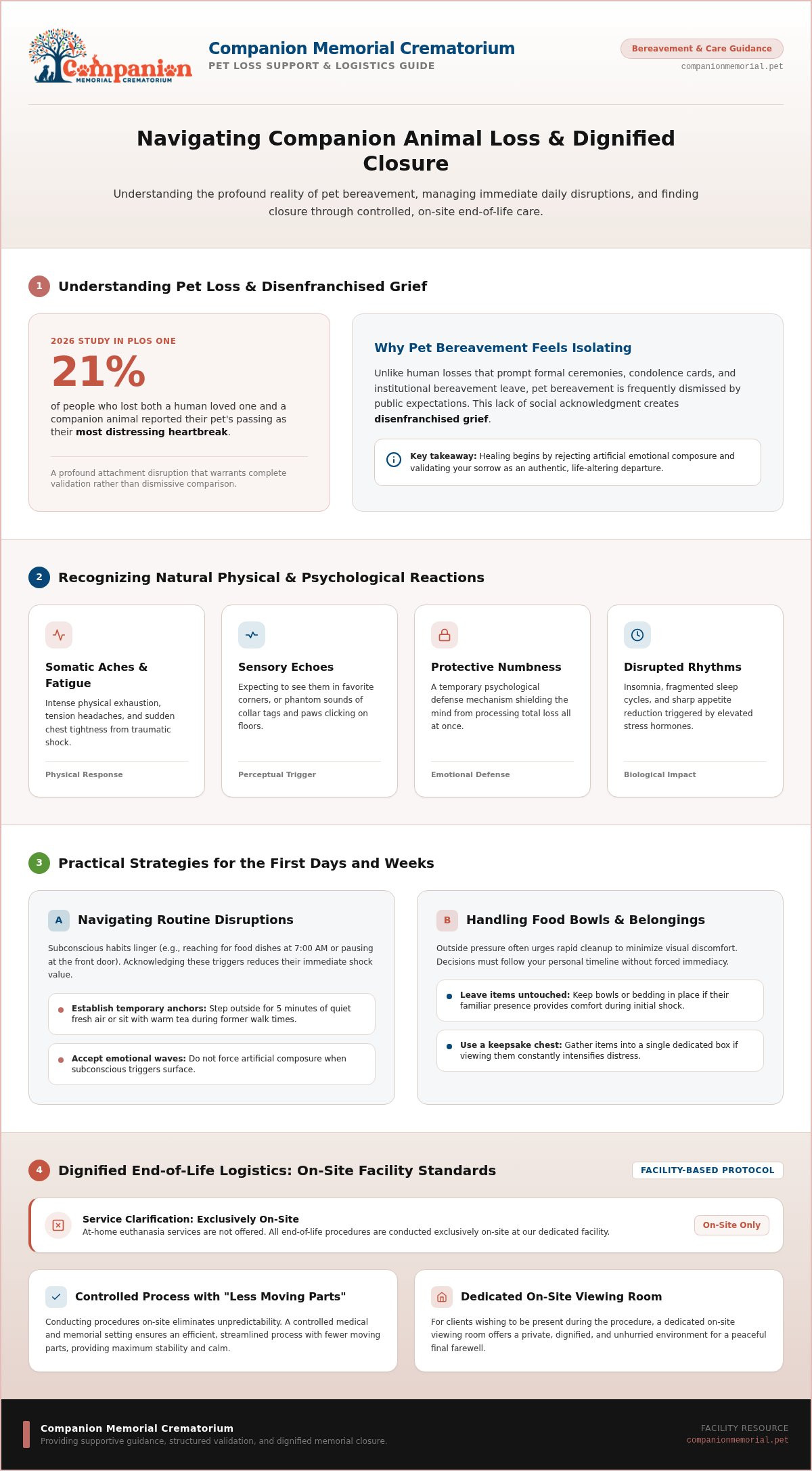
In a 2026 study published in PLOS ONE, 21% of people who had lost both a human loved one and a pet shared that their animal's passing was their most distressing heartbreak. Finding dedicated emotional support after losing a pet can feel profoundly isolating, especially when the surrounding world expects you to simply carry on. You might look across an unnervingly quiet room, facing disrupted routines and the heavy weight of lingering guilt, wondering why others treat such a devastating absence so lightly.
Your grief is completely valid, and you don't have to carry it alone. In this guide, you will discover compassionate guidance, coping strategies, and dedicated bereavement resources to navigate the profound pain of losing a cherished companion. We will examine practical tools for validating your sorrow, direct connections to professional pet loss hotlines, and peaceful memorialization rituals that provide lasting closure.
Key Takeaways
- Understand why companion animal loss represents a profound attachment disruption that deserves complete validation rather than silent dismissal.
- Discover gentle, practical strategies to manage sudden disruptions to your daily caregiving routines without forcing artificial emotional composure.
- Connect with free, confidential hotlines and community groups that provide vital emotional support after losing a pet.
- Explore peaceful memorial rituals and tangible keepsakes that transform immediate grief into lasting tributes of gratitude.
- Learn how controlled on-site procedures and dedicated viewing rooms provide an unhurried farewell with less moving parts to support peaceful closure.
Understanding Pet Loss: Why Companion Animal Grief Cuts So Deeply
Losing an animal companion strikes at the very foundation of daily life. For years, your routine evolved around their gentle presence, from morning feedings to quiet evening resting periods. When that constant thread unspools, the silence left behind in your home can feel deafening. Seeking dedicated emotional support after losing a pet is not an overreaction to an everyday hardship; it is a vital step in processing an intimate, life-altering departure.
The bond you shared was built on unconditional trust, unburdened by the complex friction often found in human relationships. To gain a clearer perspective on this emotional journey and begin steadying yourself, take a moment to watch this practical guide:
The Psychology of Disenfranchised Grief in Pet Loss
Unlike human losses that prompt formal funerals, condolence cards, and paid bereavement leave, pet bereavement is frequently dismissed as secondary. Well-meaning peers might ask when you plan to get another animal, effectively minimizing your sorrow. This lack of public recognition creates disenfranchised grief, leaving you isolated with your pain. True healing begins only when you validate this heartbreak as an authentic, profound loss that deserves patience, dignity, and time.
Physical and Emotional Symptoms You Might Experience
Bereavement impacts the physical body as intensely as the emotional state. In the immediate aftermath, you may encounter several distressing reactions that are entirely natural responses to traumatic shock:
- Somatic aches and heavy fatigue: Intense physical exhaustion, tension headaches, and sudden chest tightness.
- Sensory echoes: Momentarily expecting to see them curled up in a favorite corner, or hearing the phantom sound of collar tags and paws clicking across hardwood floors.
- Protective emotional numbness: A temporary psychological defense mechanism where your mind shields you from processing the full weight of the loss all at once.
- Disrupted biological rhythms: Insomnia, fragmented sleep, and a sharp loss of appetite driven by stress hormones.
Allowing yourself to experience these sensations without self-judgment is essential. Compassionate emotional support after losing a pet provides the structured reassurance needed to navigate this physical and emotional disorientation with quiet grace.
Immediate Coping Strategies for the First Days and Weeks
The earliest days following a companion's passing arrive with disorienting force. While shock blunts the immediate pain, everyday household rhythms suddenly become sharp reminders of your loss. Surviving this initial window does not require emotional composure or forced optimism. It requires gentle patience and deliberate steps to ground yourself when routines abruptly dissolve.
Navigating Disruptions to Your Daily Household Routine
Daily caregiving creates subconscious habits that linger long after an animal departs. Reaching automatically for food dishes at 7:00 AM, pausing before opening the front door, or listening for movement down the hall can trigger sudden tears. As the American Veterinary Medical Association emphasizes in their guidance on coping with the loss of a pet, acknowledging these habitual triggers reduces their shock value. Rather than enduring a vacuum during former walk times, step outside for a quiet five-minute breath of air, or sit with warm tea to establish a temporary resting anchor.
Deciding What to Do with Food Bowls and Belongings
Pressure to immediately clear away your companion's belongings often stems from outside onlookers trying to minimize visual discomfort. You do not have to put anything away until you are ready. Moving bowls, leashes, or orthopedic bedding should follow your own internal timeline:
- Leave items untouched if their familiar presence offers comfort during the initial shock.
- Gather belongings gently into a single basket or keepsake chest if viewing them continuously amplifies your distress, keeping them safe without forcing permanent disposal.
- Seek logistical clarity by reviewing what to do when your pet dies: a step-by-step checklist, which outlines practical steps for managing personal effects and aftercare choices with calm clarity.
Managing Unintentional Insensitivity from Friends and Family
People often stumble when responding to animal bereavement. Comments such as "at least you gave them a good life" or "you can always get another" usually stem from emotional discomfort rather than malice. You are under no obligation to educate others while bearing acute heartbreak. Prepare a quiet boundary, such as, "I appreciate your concern, but I need time to grieve this member of our family." Surrounding yourself with individuals and spaces that honor this bond offers vital emotional support after losing a pet. If you need a peaceful environment and compassionate aftercare guidance, connecting with trusted professionals like Companion Memorial can bring steady, quiet reassurance during this vulnerable transition.
Dedicated Pet Bereavement Resources: Hotlines, Counseling, and Groups
When the initial shock settles, carrying the silence alone can quickly feel unbearable. You do not have to shoulder this weight in solitude or rely on peers who cannot grasp the bond you shared. Accessible, structured emotional support after losing a pet exists through specialized veterinary crisis lines, communal grief circles, and compassionate counseling services designed specifically for animal bereavement.
Authoritative Pet Loss Helplines and Hotlines
Pet loss helplines provide free, confidential emotional first aid during moments of acute heartbreak. When you place a call, you won't encounter judgment or clinical detachment. Instead, a trained volunteer listens patiently as you speak about your pet, your guilt, or the unbearable stillness of your home. Several veterinary institutions provide exceptional support:
- Cornell University Pet Loss Support Helpline (607-218-7457): Staffed by trained veterinary students who provide compassionate listening during evening hours. Cornell also maintains an extensive archive of verified pet loss resources and support for grieving families.
- Tufts University Pet Loss Support Helpline (508-839-7966): Administered through the Cummings School of Veterinary Medicine, offering dedicated evening shifts backed by a 24-hour voicemail callback service.
- Chicago Veterinary Medical Association Helpline (630-325-1600): A long-standing regional lifeline where trained veterinary volunteers return evening messages to assist callers through acute distress.
Finding Support Groups and Professional Bereavement Therapy
While telephone hotlines offer immediate de-escalation, sustained processing often thrives in a shared environment. Virtual and regional support groups, frequently facilitated by licensed veterinary social workers, connect you with individuals walking the exact same path. In these meetings, you are welcome to speak openly about your companion or simply listen with your camera off until you feel steady enough to share.
When deep depression, unrelenting fatigue, or debilitating guilt persist for months without easing, professional intervention becomes an invaluable resource. Licensed counselors who specialize in veterinary bereavement help untangle complex trauma around sudden accidents, terminal diagnoses, or end-of-life decisions. Pairing specialized therapy with therapeutic grief journaling gives your sorrow a dedicated, private outlet, transforming raw isolation into quiet psychological recovery.
Meaningful Memorialization: Creating Lasting Tributes and Rituals
Grief often feels shapeless, leaving you with an overwhelming volume of love that no longer has a physical recipient. Establishing structured memorial rituals offers a gentle container for that love, transforming acute anguish into enduring gratitude. Tangible tributes don't erase the ache of absence; instead, they anchor your memories, ensuring your companion's loyalty and joy remain an acknowledged part of your home.
Keepsakes, Urns, and Tangible Tributes
Selecting lasting keepsakes offers tangible reassurance during the quietest moments of mourning. Holding a concrete physical anchor can steady you when anniversary dates or sudden waves of sadness surface:
- Dedicated Urns: Handcrafted memorial urns keep your pet safely close within a prominent, peaceful corner of your living space.
- Official Cremation Certificates: Formal documentation that honors your companion's life story and validates their place as an irreplaceable family member.
- Physical Keepsake Spaces: Preserving a favorite collar, paw-print impression, or lock of fur inside an open memory box creates a dedicated sanctuary for quiet reflection.
If you live in upstate New York, exploring pet memorial services in Sullivan County, NY can help you design commemorative tributes that reflect your companion's true personality.
Commemorative Rituals for Families and Children
Memorial ceremonies provide young children and adults with a shared language for grief. Children frequently struggle with abstract explanations, making tangible rituals essential for processing finality. Invite family members to write farewell letters, sketch favorite shared memories, or plant a flowering tree that blossoms year after year in their memory.
Gathering together for an intentional, private farewell allows everyone to voice heartfelt stories without rushing. Dedicated memorialization serves as an invaluable pillar of emotional support after losing a pet, providing comfort that deepens as the years pass. If you are preparing to preserve your pet's legacy, browse memorial urns and aftercare services to find an enduring tribute crafted with reverence and quiet care.
Finding Peace and Closure Through Dignified End-of-Life Care
Choosing to relieve a declining companion's discomfort represents one of the most selfless acts of love an owner can offer. Yet, reaching that conclusion frequently summons profound internal conflict and lingering guilt. Cultivating healthy emotional support after losing a pet begins with how you say goodbye. The setting where this final parting takes place directly shapes your memory of the transition, either amplifying anxiety or providing a grounded sense of quiet peace.
The Peace of Controlled On-Site Care Environments
All procedures at Companion Memorial Crematorium take place strictly on site at our Ferndale facility. We do not provide at-home euthanasia services. Conducting these procedures entirely within our tranquil, specialized facility creates an environment with less moving parts. A household setting often introduces unpredictable variables, such as doorbell interruptions, street traffic, or other agitated household pets. An on-site arrangement eliminates those logistical stresses, allowing our team to maintain complete environmental control while you focus entirely on your companion. For a detailed overview of what to expect, review our guide to on-site pet euthanasia in Ferndale, NY.
The Healing Role of Private Viewing Rooms and Cremation
A critical step toward lasting closure is having unhurried time in a protected setting. Our facility features a dedicated private on-site viewing room designed specifically for families who wish to stay by their pet's side. Within this quiet sanctuary, you can hold your companion, speak final words, and express tears without clinical rush or outside observation.
Following this peaceful parting, arranging dignified aftercare ensures their memory is honored with absolute reverence. Selecting private pet cremation guarantees your pet receives individual care throughout the process, returning their ashes safely to you alongside an official cremation certificate. Discovering lasting comfort through private pet cremation and dignified care can soften the sting of bereavement, anchoring your heart with the certainty that their final moments were met with dignity, gentle hands, and profound respect.
Embracing Healing and Honoring an Unbroken Bond
Navigating companion animal loss is a deeply personal journey that requires patience, self-compassion, and gentle validation. Recognizing your sorrow as an authentic attachment disruption, establishing steady household anchors, and leaning into dedicated bereavement helplines will help you steady yourself through the hardest days. Finding reliable emotional support after losing a pet reminds you that while routines change, the devotion you shared never fades.
When the time comes to arrange aftercare, choosing a controlled setting brings profound relief. As a 100% combat veteran-owned facility, Companion Memorial Crematorium conducts all procedures strictly on site, ensuring a calm experience with less moving parts to protect your peace of mind during grief. Families can gather without distraction in our dedicated private on-site viewing room before proceeding with individual private cremation and receiving an official cremation certificate. Connect with Companion Memorial Crematorium to find steadfast guidance, honorable care, and quiet comfort as you pay tribute to a lifetime of unconditional love.
Frequently Asked Questions
Is it normal to grieve the loss of a pet as much as a human family member?
Yes, grieving a pet as deeply as a human family member is entirely natural and clinically recognized. Daily routines, unconditional affection, and constant companionship create an intense primary attachment bond. When an animal passes away, that physical presence vanishes instantly. Seeking specialized emotional support after losing a pet helps validate your heartbreak and confirms that the depth of your sorrow directly reflects the profound loyalty you shared.
What should I do immediately after my companion animal passes away at home?
Place your companion gently in a cool, quiet room and position them comfortably on their side over a clean blanket or towel. Because Companion Memorial Crematorium does not offer pet pickup services, you will need to arrange safe transport directly to a professional care center. Contact an aftercare facility in your region, such as Ferndale, New York, to coordinate timely on-site intake and discuss your preferences for individual or private cremation.
How can I support my children through their first experience with pet loss?
Use clear, honest language rather than confusing euphemisms like "went to sleep" or "passed away." Children need concrete explanations to understand that their companion's body has stopped working and will not return. Encourage them to draw pictures, share funny memories, or help choose a special keepsake urn. Allowing them to see your own sadness models healthy emotional expression and teaches them that mourning love is nothing to hide.
Where can I find free pet loss support groups and telephone helplines?
Free, compassionate assistance is readily available through academic veterinary helplines and nonprofit community groups across New York, New Jersey, Pennsylvania, and Connecticut. Volunteer veterinary counselors answer calls through established lines at Cornell University and Tufts University. Many veterinary hospice organizations also host free weekly virtual video circles, offering grieving owners a dedicated space to connect with understanding peers who share their pain.
Can our surviving pets also experience depression and grief after losing their companion?
Surviving animals frequently display acute grief symptoms following the loss of a pack mate. Dogs and cats often wander from room to room, whine, lose interest in meals, or cling tightly to their human guardians. Maintain their existing feeding and exercise routines to preserve a sense of household stability. Provide extra affection and patience while monitoring their behavior closely, as familiar structure helps them process the sudden domestic void.
How do I know when it is the right time to consider humane euthanasia?
Assessing overall quality of life provides the clearest indicator for this selfless decision. Evaluate whether your companion still experiences more comfortable days than painful ones by monitoring their mobility, appetite, hydration, hygiene, and interest in family interactions. When medical management no longer relieves persistent distress or breathing difficulties, consulting your veterinarian about humane end-of-life care ensures your pet's transition remains peaceful, compassionate, and dignified.
Why do families choose on-site veterinary facilities over home visits for final goodbyes?
Families choose on-site procedures because a dedicated facility provides complete environmental control with far less moving parts. Performing end-of-life care on site eliminates unpredictable household interruptions, such as street sounds or ringing phones, while keeping difficult medical memories away from your living room. At Companion Memorial Crematorium in Ferndale, NY, families gather in a dedicated private on-site viewing room, ensuring an unhurried, peaceful farewell supported by quiet professional dignity.


