

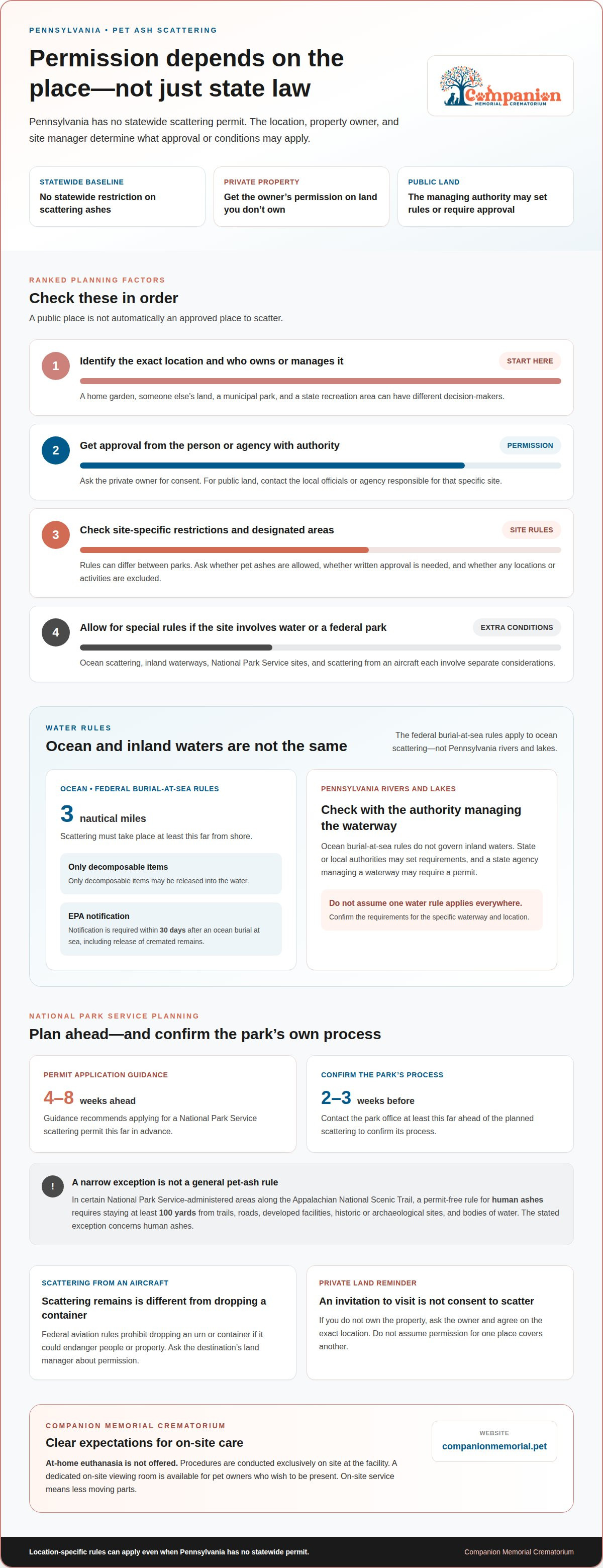
Pennsylvania’s pet ash scattering laws don’t impose a statewide restriction on scattering ashes, but the location matters. On someone else’s private property, get the owner’s permission. On public land, local officials or park authorities may set conditions or require approval. The state rule is only part of the answer.
It’s understandable to want a peaceful, meaningful place while respecting the people responsible for that land. This guide explains where pet ashes may be scattered in Pennsylvania, when permission may be needed, and why rules can differ for private property, public parks, and waterways.
You’ll also learn what to consider before choosing a location, so you can plan thoughtfully without assuming permission for one place applies everywhere.
Key Takeaways
- You may scatter ashes on property you own, while another person’s land requires the owner’s permission.
- Public parks and other shared spaces can have location-specific rules, so identify who manages the site before planning a memorial.
- Separate rules may apply to ocean scattering and inland waterways; the type of water and location affect what’s permitted.
- Pennsylvania has no statewide scattering permit, but local authorities and individual sites may require approval.
- You can also choose to keep cremated remains at home, inter them, or place them in a cemetery, columbarium, mausoleum, or scattering garden.
Can You Scatter Ashes on Private Property?
In Pennsylvania, state law doesn’t restrict scattering ashes on property you own. If the land belongs to someone else, get the owner’s permission before choosing a memorial site.
Scattering on Private Land
Private land is property owned by an individual or organization. Pennsylvania has no state law restricting scattering ashes in a yard or on other property you own. That distinction matters: a familiar garden at your home is different from a relative’s land, even if you visit often or have permission to use it for other purposes.
If you wish to scatter ashes in your backyard, the state doesn’t restrict that choice. If you’re considering a family member’s garden or a privately owned field, ownership changes the permission question. Identify who owns the specific spot, not just who maintains it or lives nearby. Property lines can matter when a quiet memorial site is close to a neighboring yard.
Permission from Property Owners
Permission means the property owner has agreed to scattering ashes on their land. Pennsylvania guidance calls for getting the owner’s consent before scattering on someone else’s property. This matters even when the place feels personal, such as a friend’s garden or a family cottage. Respecting the owner’s decision helps ensure a memorial doesn’t become an unwanted use of private property.
Before making plans, speak with the owner and describe the exact location you have in mind. If several people share ownership, find out who has authority over the property and seek clear agreement. A written message can help everyone remember what was approved, including whether permission applies to one visit or a particular area. Don’t assume an invitation to visit includes consent to scatter remains.
Public and Private Land
Private land belongs to an individual or organization; public land is managed by a government body. The distinction matters because different decision-makers grant permission. On another person’s private property, seek the owner’s consent. On public land, local officials or the agency responsible for the site may set conditions or require approval.
A town park may look open to visitors, but public access doesn’t by itself establish permission to scatter ashes there. Find out which authority manages the specific location and whether its rules allow a memorial scattering. Water also has separate considerations: ocean scattering under burial-at-sea rules must take place at least three nautical miles from shore, according to the U.S. Environmental Protection Agency. That distance concerns ocean scattering, not a backyard or public park.
Where to Scatter Ashes in Pennsylvania?
Pennsylvania public land may allow scattering with local officials’ consent, while federal sites and national parks follow location-specific restrictions. For a boat, ocean scattering must occur at least three nautical miles from shore, and the U.S. Environmental Protection Agency requires notification within 30 days afterward. Federal aviation rules prohibit dropping an urn or container if it could harm people or property.
Scattering on Pennsylvania Public Land
Public land includes places managed by government bodies, such as municipal parks or state recreation areas. In Pennsylvania, scattering ashes on public land may require local officials’ consent, so public access alone doesn’t mean scattering is allowed. The managing authority and the specific site determine what approval or conditions apply.
A county park and a state park may have different rules, even if both have trails and open grounds. Identify who manages the exact location, then ask whether scattering is allowed and whether there are designated areas. Don’t assume permission for one park applies to another. Cemeteries also have their own management and policies, distinct from general public land.
Permits and Land Manager Questions
A permit is formal authorization from the agency responsible for a site. Many National Park Service units require a free Special Use Permit for scattering, while individual national parks set their own restrictions. Ask the land manager whether pet ashes are allowed, whether written permission is needed, and which locations or activities are excluded.
Plan around the specific park’s process. Guidance recommends applying for a National Park Service scattering permit 4-8 weeks ahead, and contacting the park office at least 2-3 weeks before the planned scattering to confirm its process. In certain National Park Service-administered areas along the Appalachian National Scenic Trail, a permit-free rule for human ashes requires staying at least 100 yards from trails, roads, developed facilities, historic or archaeological sites, and bodies of water. That stated exception concerns human ashes, so don’t treat it as a general pet-ash rule.
Water rules depend on the location. The ocean’s federal burial-at-sea rules require scattering at least three nautical miles from shore, with only decomposable items released into the water. The EPA’s 30-day notification requirement applies after an ocean burial at sea, including release of cremated remains. Pennsylvania rivers and lakes aren’t governed by those burial-at-sea rules; state or local authorities may set requirements, and a state agency managing a waterway may require a permit.
Scattering from an aircraft raises a separate concern: Pennsylvania has no state law restricting it, but federal aviation law prohibits dropping an urn or container if it could endanger people or property. Distinguish scattering remains from releasing a container, and ask the land manager about permissions for the destination below.
Pet ash scattering laws and permissions
Pennsylvania has no state law restricting the storage or scattering of a person’s or pet’s ashes. It also has no statewide permit for scattering. For pet ash scattering laws in Pennsylvania, the key distinction is between state rules and site-specific requirements. A property owner, park authority, or agency managing a location may set separate conditions.
Permission depends on the exact place. Consent to scatter on one private property doesn’t grant permission at a nearby municipal park. Likewise, approval for one public location doesn’t automatically extend to another managed by a different agency. Before planning a ceremony, identify who controls the specific area and which rules apply.
For a privately owned garden, speak with the property owner. For public land, contact the responsible local or state office. At a national park, ask the park authority about its regulations, written approval, and permitted locations. Public access doesn’t necessarily mean scattering is allowed.
Waterways involve another distinction. Pennsylvania rivers and lakes are inland waters, not ocean burial-at-sea locations, so federal ocean rules don’t determine every local requirement. State or local authorities may set conditions for inland waterways, and the agency managing a waterway may require a permit. A ceremony beside a lake and scattering remains into it are different plans.
Scattering gardens and cemeteries can provide designated memorial settings, but their rules come from their managers. Ask whether pet cremated remains are accepted, which areas may be used, and whether a gathering must follow site conditions. Permission for a cemetery garden applies to that site, not nearby public land.
Understanding Pennsylvania’s pet ash scattering laws means separating three questions: what statewide rules say, who manages the chosen location, and what that manager permits. Keep a record of the location and any consent received. If the site treats scattering, placing remains in a container, or holding a gathering differently, follow the conditions for each activity.
Families may also keep cremated remains at home, inter them, or place them in a cemetery, columbarium, or mausoleum. These options offer an alternative if a preferred scattering location has restrictions or doesn’t suit the remembrance planned.
State, county, and local park policies
Do Pennsylvania cities or counties have local rules for scattering pet ashes? They may set local requirements, even though Pennsylvania has no statewide permit. Distinguish statewide rules from the policies of the city, county, or park managing your chosen location.
Pennsylvania’s 121 state parks don’t necessarily share one scattering policy. Contact the office for the specific park and ask whether scattering is allowed, which locations are appropriate, and whether written approval is required. A rule for one park doesn’t automatically apply at another, even when both are managed by the same state agency.
County and city parks have their own land managers. A county park, for example, may have different rules from a municipal park in the same county. Before planning a memorial, identify the property’s manager through the relevant city or county office. Ask about scattering, gathering with family, and any limits on where people may go.
Water requires particular care. Pennsylvania’s inland lakes and rivers aren’t covered by federal burial-at-sea rules; state or local authorities may set requirements. Local guidance also says ashes cannot be scattered in lakes, streams, or other local bodies of water. A lakeside gathering and scattering ashes into the lake are different activities, so ask the waterway manager about the exact location and plan.
National parks and other federal lands follow site-specific policies, not one rule for every location. Most National Park Service units require a free Special Use Permit for scattering, while each park sets its own regulations. The National Park Service also has a specific permit-free exception for human ashes in certain areas along the Appalachian National Scenic Trail. That exception has distance conditions and shouldn’t be assumed to cover pet ashes.
For ocean scattering, federal burial-at-sea rules require a distance of at least three nautical miles from shore. The U.S. Environmental Protection Agency requires notification within 30 days after an ocean burial at sea, including the release of cremated remains. Those ocean requirements don’t determine what a Pennsylvania city allows along an inland shoreline.
Keep your questions focused on the exact activity. Ask whether scattering is permitted, whether a permit or written consent is needed, and whether containers or other memorial items are allowed. If the answer differs for a park lawn, trail, or water’s edge, plan around the approved location and conditions rather than assuming the entire property is available.
Pennsylvania laws on scattering cremated remains
Pennsylvania has no state law restricting the storage or scattering of a person’s or pet’s ashes. Practical rules still depend on the property, park, or waterway you choose.
Rules for Scattering Cremated Remains
Pennsylvania’s statewide rule leaves families room to choose how to keep or memorialize cremated remains. That matters because scattering isn’t the only option if a preferred location has restrictions.
After the authorizing agent receives the remains, families may keep them at home, inter them, or scatter them. Other options include a cemetery, columbarium, mausoleum, or scattering garden. Each location has its own manager and conditions, so permission for one place doesn’t extend to another. Approval to use a cemetery’s scattering garden, for example, applies to that site, not a nearby county park.
Scattering Ashes in Waterways
Waterway rules depend on whether the location is inland or at sea. This distinction matters because Pennsylvania rivers and lakes aren’t governed by federal burial-at-sea rules.
For a Pennsylvania lake, stream, or other local body of water, the stated guidance says ashes cannot be scattered there. Inland-water requirements may also come from state or local authorities, including the agency managing a waterway. A lakeside memorial without releasing remains is different from scattering into the water. For ocean scattering, the U.S. Environmental Protection Agency’s burial-at-sea rules apply; they don’t establish permission for a Pennsylvania county lake.
Risks and Penalties Without Permission
Risks of scattering without permission depend on the rules of the specific property or site, rather than one statewide penalty. A private owner, county park, and federal park each operate under different authorities.
Pennsylvania has no statewide scattering permit, but individual locations can set rules or require approval. Scattering on someone else’s property without consent conflicts with the requirement to obtain the owner’s permission. A park’s permit or location restrictions also apply specifically to that park. The available statewide facts establish no universal penalty or consequence, so don’t assume one sanction applies across Pennsylvania. Instead, identify the site manager and understand the location’s permission requirements before a ceremony.
Families considering a different memorial can keep remains at home or choose interment instead of scattering. If you’re arranging cremation as part of that decision, explore private cremation arrangements.
Companion Memorial Crematorium: Private Cremation
Companion Memorial Crematorium offers private cremation for families deciding how to honor their pet’s remains. Individual and group cremation are also available, giving families different options as they consider a memorial or scattering plan.
Private viewings are available in a dedicated on-site viewing room. On-site euthanasia is provided only for pets facing suffering or a significantly reduced quality of life, and takes place at the facility, not at home. The facility offers families a dedicated setting for a private goodbye.
If you’re considering cremation for your pet, contact Companion Memorial Crematorium or visit companionmemorial.pet.
Choose a remembrance that feels right
Pennsylvania’s pet ash scattering laws can shape the practical plan, but they don’t define the meaning of your farewell. Consider what would feel most fitting: a place connected to a shared memory, a quiet moment with family, or another way to keep your companion close. You don’t need to decide every detail at once.
A useful next step is to talk through the kind of care you want for your pet and what would help you feel settled about the arrangements. Companion Memorial Crematorium can be part of that conversation as you consider your pet’s cremation and the memorial that follows. You can contact Companion Memorial Crematorium to discuss your next step.
Choose at a pace that feels manageable. A thoughtful farewell can begin with one clear decision, made with care for the bond you shared.
Frequently Asked Questions
Do I need a permit to scatter ashes at Gettysburg?
Plan to obtain permission from Gettysburg’s park authority before scattering ashes there. National Park Service rules vary by location, and most of its units require a free Special Use Permit. Ask the Gettysburg park office whether its policy covers pet ashes, which area may be used, and whether written approval is required. Don’t assume a rule for another park, trail, or memorial site also applies at Gettysburg.
Is it legal to scatter pet ashes in my backyard?
Yes, Pennsylvania has no state law restricting scattering ashes in a yard on property you own. You may choose a quiet area of your garden for a private remembrance. If the yard is shared or the property has multiple owners, make sure the person with authority over the land agrees. A neighbor’s adjoining yard remains separate property, even if it feels like part of the same home setting.
Are there Pennsylvania state laws regulating the scattering of pet ashes?
Pennsylvania has no state law restricting the storage or scattering of a person’s or pet’s ashes, and it has no statewide scattering permit. That doesn’t override rules for particular properties or public sites. A town park or cemetery, for example, may have its own requirements. The question is not only whether state law allows scattering, but also who manages the specific location you’re considering.
Can pet ashes be scattered on private property in Pennsylvania without permission?
You may scatter ashes on property you own, but get permission before scattering on someone else’s land. This applies even if you’re a relative, frequent visitor, or have permission to use the property for other purposes. A family gathering at a relative’s home, for instance, doesn’t automatically include consent to scatter remains in the garden. If ownership is shared, seek agreement from whoever is authorized to decide.
Can pet ashes be scattered in Pennsylvania state parks or public lands?
Potentially, but public access alone doesn’t grant permission to scatter ashes. Pennsylvania public lands may allow scattering with local officials’ consent, and each park can set location-specific requirements. Before choosing a trail, lawn, or overlook, find out which office manages the site and whether scattering is allowed. A policy for one state park shouldn’t be treated as approval for another park or public property.
Are permits required to scatter pet ashes in Pennsylvania?
No statewide Pennsylvania permit is required for scattering ashes, but a specific park or public site may require approval. Most National Park Service units require a free Special Use Permit for scattering ashes, and each park has its own regulations. Ask the site manager whether pet ashes are covered, whether written authorization is needed, and whether approval applies to your chosen location. Local consent and a federal park permit are separate from a statewide permit.
Where can pet ashes legally be scattered in Pennsylvania?
Possible settings include property you own, private land with the owner’s permission, and public land where the responsible authority consents. Cemetery and scattering-garden options depend on the site’s rules. Pennsylvania rivers, lakes, and other local waterways raise separate considerations, so don’t assume permission to use land allows scattering into water. For any location, identify its owner or manager first, then understand the rules for that place and your planned memorial.


